

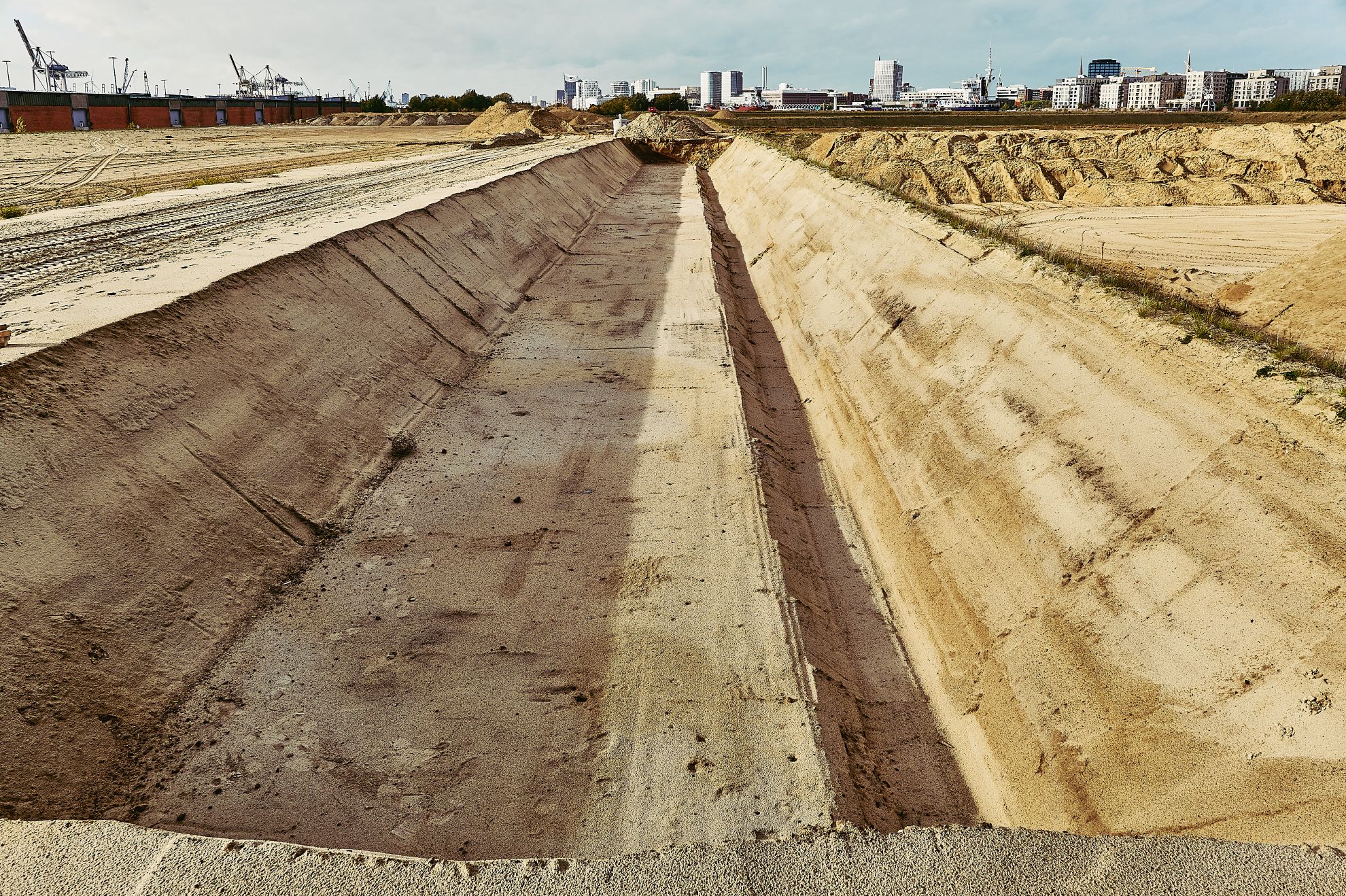
Construction of the surface reservoir for the smart " stormwater management " project at Grasbrook. Photo: Stefan Groenveld
While rainwater is often quickly drained into the sewer system in many places, Hamburg’s new Grasbrook neighborhood is taking an innovative approach: Here, this valuable resource is collected in a large-scale underground storage facility and put to use. With the start of construction on this groundbreaking infrastructure project, climate adaptation is being put into practice in the “ Moldauhafenquartier ” (Green City) initiative.
The “ stormwater management ” for Grasbrook is based on the principle of “ Sponge City ”—a key focus area of climate-resilient urban development in Germany. This principle refers to the ability of urban neighborhoods to store rainwater “like a sponge” and then release it through evaporation, infiltration, or irrigation. In Grasbrook, this principle will ensure that precipitation is used in the future right where it falls. With a capacity of 6.3 million liters, the underground surface storage systems provide the foundation for a local water cycle. Conversely, conventional storm drains in the street right-of-way can largely be eliminated. The planning approach—which aligns the drainage system with the future water needs of urban green spaces—is innovative and unique. Developed in collaboration with HAMBURG WASSER, the concept sets new standards for stormwater management and serves as a key component of sustainable urban development.
Construction on the first sections of the storage system has been underway since October 2026 and is scheduled to be completed by early 2027. The underground storage facilities are expected to be fully constructed by 2030.
Dr. Andreas Kleinau, Chairman of the Executive Board of the HafenCity Hamburg GmbH
“Heat, heavy rain, flooding, and drought—our cities are particularly affected by these phenomena. The smart “stormwater management ” in Grasbrook offers a solution. The underground storage tanks ensure that precipitation can be used as a valuable resource for the neighborhood. The water is immediately available to irrigate the vegetation. At the same time, the storage tanks help better manage heavy rain events. This makes the new neighborhood attractive in the long term and well-suited for its diverse uses, including work, housing, recreation, and culture.”
Another milestone was also reached for the new Grasbrook neighborhood in terms of low-emission heating and cooling: With the awarding of the concession in October, the City of Hamburg’s Energy and Water Supply Authority ( HafenCity Hamburg GmbH ) secured a networked system for the generation and delivery of energy. From the outset, at least 90 percent of this energy will come from renewable sources and unavoidable industrial waste heat. The cooling supply is provided entirely through renewable energy. The share of renewable energy for the heating supply in Grasbrook will also be gradually increased to 100 percent. The heating supply there will also begin in 2031.
The first lots in the “ Moldauhafenquartier ” will go on the market in December 2026 and will be available for development starting in 2028.