

Utilization concept
© moka-studio GbR
City for all
Grasbrook is intended to become a neighborhood where people of different income levels, age groups, and backgrounds can live. More than one-third of the apartments will be subsidized, thereby fostering social diversity. A mix of uses and amenities for living, working, and daily life will create a vibrant sense of diversity and urban character.
In addition to housing and workplaces, Grasbrook will also have restaurants, cultural, sports and leisure facilities and shopping opportunities, as well as an elementary school, daycare centers, medical care and much more. A variety of workplaces will help people with different professional qualifications to find work in Grasbrook.
Distribution of use
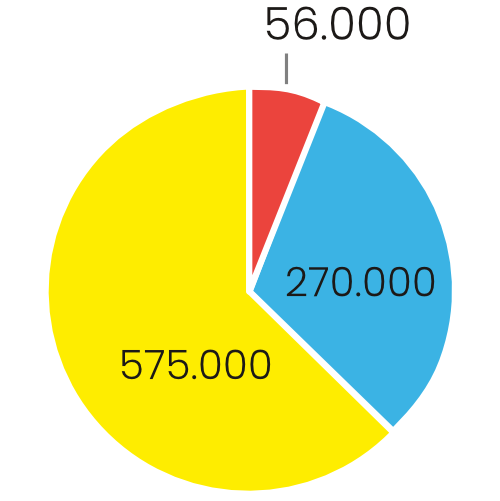
Grasbrook district
total: approx. 900,000
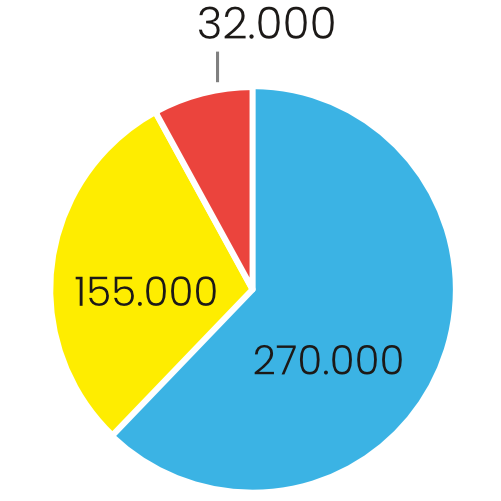
Moldauhafenquartier
total: 457,000
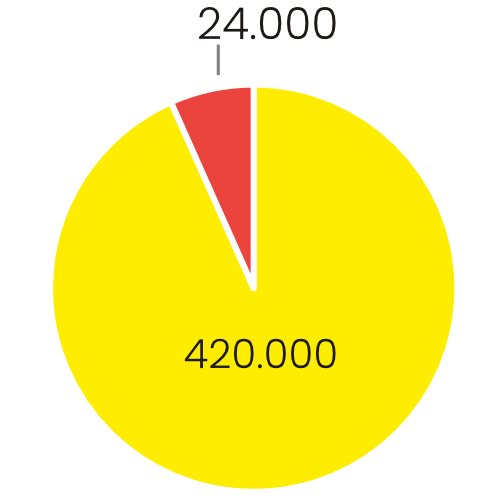
Hafentorquartier
total: 444,000
Distribution of use according to gross floor area above ground in m²
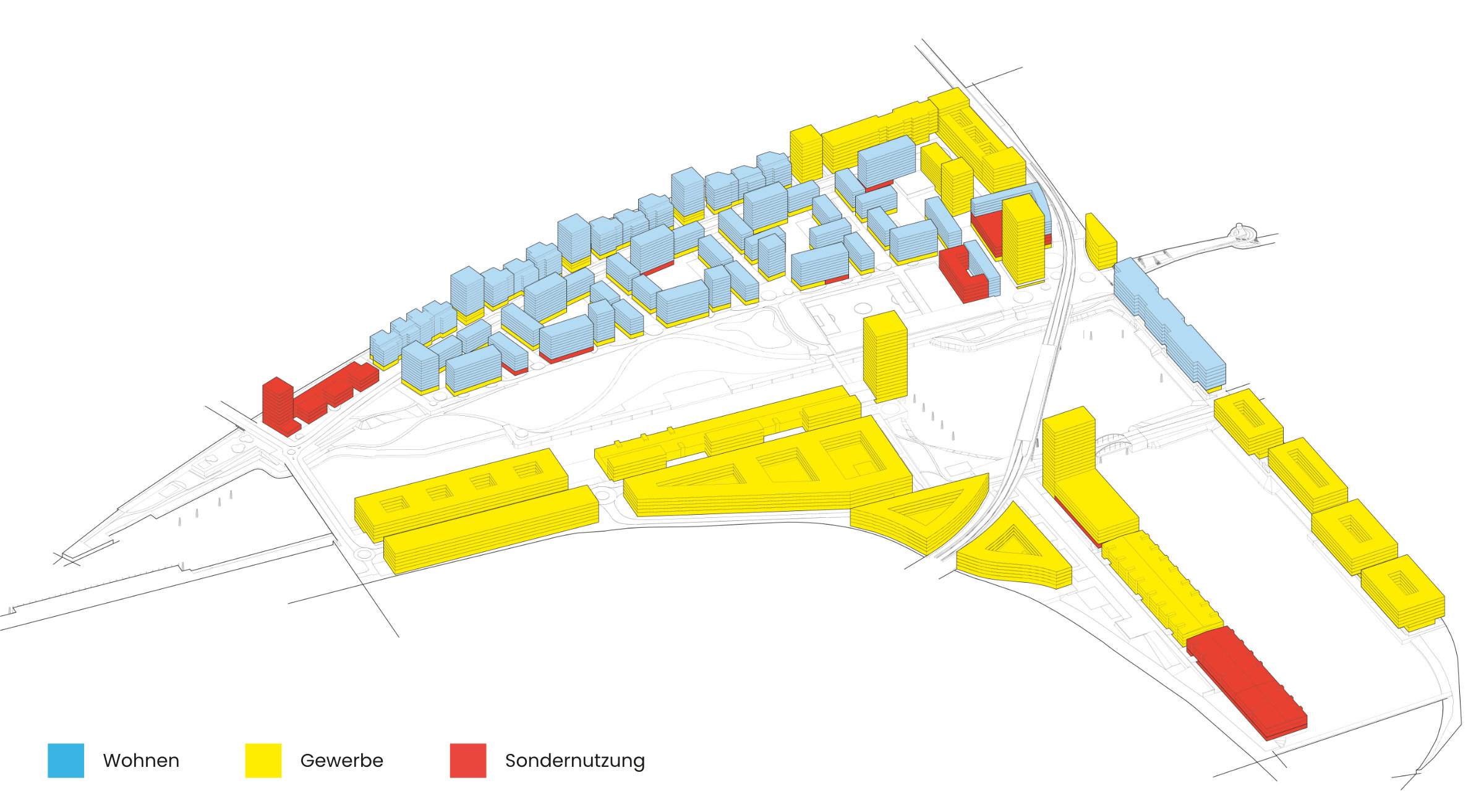
Distribution of uses in Grasbrook © büro luchterhandt & partner
© Herzog & de Meuron
Busy ground floors
The urban character of Grasbrook is created not least by the life on the streets and squares.
Local amenities, retail outlets, restaurants, medical care and services can be found in the center of the district on the city square. The elementary school and the nearby "Community Center", which could offer a library, a district canteen and rooms for various advisory services and events, are also centrally located here.
Even in the two main residential areas, the "residential islands" and the houses on the "north edge", the apartments are generally only located on the upper floors. Depending on the location and expected visitor frequency, the ground floors – for example on the Elbe promenade or by the central park – could be occupied by cafés or galleries. In the less frequented locations, small offices, outpatient care services or advisory services and communal areas are more likely to be provided.
In the commercial area Hafentorquartier, the ground floor zones are to be occupied by company or public canteens, showrooms, transparent production facilities and the like, thus helping to avoid closed building fronts.
© Herzog & de Meuron
Diverse forms of housing
A socially just city is also based on the coexistence of population groups from different ethnic and social backgrounds.
Grasbrook is to become a socially mixed district for everyone – regardless of income, age and origin. Of the approximately 3,000 apartments, at least 35 percent will be publicly subsidized rental apartments, a significant proportion of which will be for those urgently seeking housing. Up to 20 percent of the apartments will be reserved for building cooperatives.
The different building typologies in the "residential islands" and at the "north edge" in the Moldauhafenquartierallow a high degree of flexibility in terms of the number of apartments, apartment sizes and floor plan concepts. This also creates the conditions for different developer models: from independent housing companies to cooperative building associations, social organizations, foundations or cooperatives. In addition to the diversity of the future residents, this also contributes to a varied architecture. The housing supply is also intended to complement the existing stock in the neighboring districts in a meaningful way, for example to provide people from Veddel with new housing options.
Regardless of the type of housing, consistently high building standards and sustainable construction methods are just as binding as convenient, barrier-free access to the green courtyards and rooftops for all residents. Communal areas inside the building, in the courtyards and on the roofs are also intended to create meeting places and promote social participation.
© moka-studio GbR
Working environments in Grasbrook
Hafentorquartier is being developed as a forward-looking commercial and office hub for port-related activities, as well as for research and development, urban production, and modern forms of office work.
With a total of 16,000 jobs in the entire district, jobs and apprenticeships are also being created close to home for people from the surrounding districts of Veddel, Wilhelmsburg, Rothenburgsort and HafenCity. Craft businesses, manufacturers, service companies and start-ups are just as welcome here as large companies or research institutions. The aim is to create a variety of jobs for people with different qualifications in order to achieve as heterogeneous a socio-economic structure as possible.
The three listed warehouses in the Hafentorquartier are to be retained and opened up for pioneering uses, for example in the cultural and creative industries. With appropriate redevelopment and conversion concepts, the areas can be reconfigured, for example, to enable smaller-scale use or flexible expansion for growing companies.
The striking high-rise buildings at Hafenbeckenpark mark the center of Grasbrook as a group of three individual buildings of the same height. Thanks to their versatile subdivision options or vertical stacking, they offer the best conditions for the establishment of small-scale offices through to large companies in a prominent waterfront location.
Lagerhäuser F and G at the Saalehafen © Thomas Hampel
Listed warehouses
Three historic warehouses from different eras are listed at Hafentorquartier : Lagerhäuser D ("ripening facility"), F and G. They are to be largely preserved and repurposed.
Lagerhaus G
The oldest building in the area is Lagerhaus G, built in 1903 in the very south of the Hafentorquartier at the Dessauer Straße. Due to its exposed waterfront location at the Saalehafen, the historic building, together with the adjoining Lagerhaus F, forms an impressive backdrop along the edge of the Saalehafen waterfront and shapes the view of the district from the south.
The striking brick building is a ground storage facility that was used to store tobacco and cocoa, among other things. From June 1944 to April 1945, the building was used as a satellite camp of the Neuengamme concentration camp and, like the adjoining buildings, as a forced labor camp for prisoners of war who had to carry out clean-up work in the port. A memorial to document forced labor and satellite camps during the Nazi era is to be created in one part of Lagerhaus G.
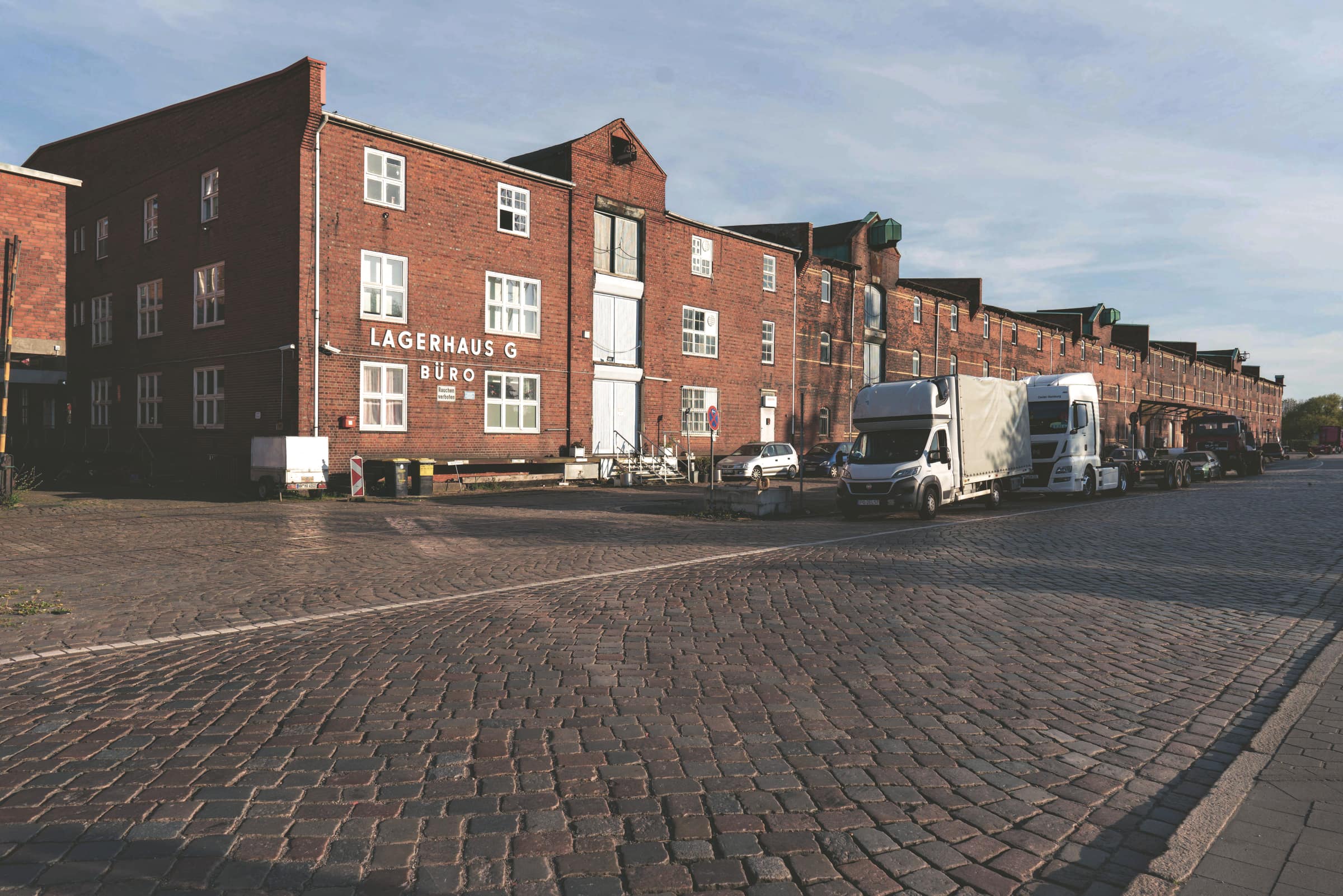
Lagerhaus G seen from the land side © Thomas Hampel
Lagerhaus F
Lagerhaus F is located directly north of Lagerhaus G and was partially identical in construction to it, but was destroyed during the Second World War and rebuilt on the old foundations between 1957 and 1961. In addition to the original foundations, some old parts of the building, e.g. the crane portals, were also reused.
Like its predecessor, Lagerhaus F forms Lagerhaus F urban unit with Lagerhaus G. The buildings are arranged in a straight line along the Dessau riverbank. At regular intervals, diagonally projecting winch houses divide the east and west facades vertically. They were used for loading goods. On the waterfront side, goods were hoisted from the barges into the warehouse using cable winches or slewing cranes, and on the landward side, they were loaded onto trains or trucks.
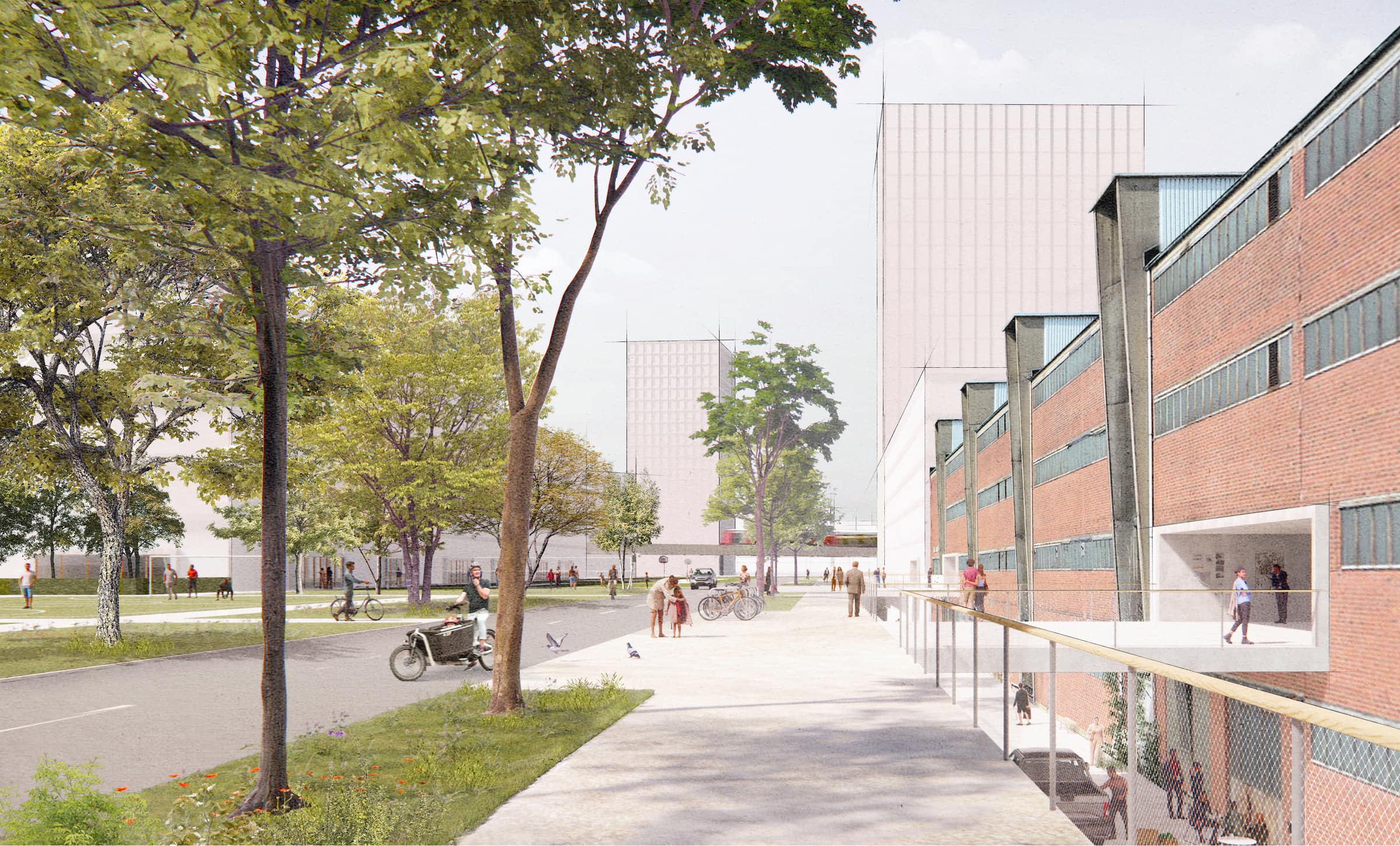
Future plans and impressions of the Dessauer Straße in the area of Lagerhaus F © Herzog & de Meuron
Lagerhaus D ("Bananenreiferei")
Lagerhaus D (built in 1958) at the eastern end of the Melnik bank at Moldauhafen is also a listed building. It is a single-story hall building with a clear height of around 10 meters, which was rebuilt on the old foundations of a previous building from 1914 that was destroyed in the Second World War. The exterior of the red-brick building with its projecting winch houses also resembles that of Lagerhaus F, which was erected at the same time. The single-story building will be used for a few more years as a ripening facility for tropical fruits and as a nut warehouse before a new building will be erected elsewhere in the port and the building gets vacated.
Stefan Groenveld
Education, neighborhood and culture
Grasbrook will be a family-friendly district with a good social infrastructure and cultural highlights such as the museum ship "Peking" and the planned German Port Museum.
The elementary school is being built directly on the city square and is therefore within safe walking distance for primary school children from Grasbrook and also from Veddel. The schoolyard merges into an adjacent sports field, behind which the park begins immediately. In front of this is the "roof", a weatherproof open space. All of these areas give pupils plenty of space to move around in addition to the school playground.
A total of seven daycare centers with around 750 places are planned across the district – five of them in the central residential area of the Moldauhafenquartier, the other two in the Hafentorquartier. All daycare centers have directly connected and easily usable outdoor play areas, which are protected in the inner courtyards of the block structures.
A community center is planned as a central neighborhood meeting point – either on the city square or in the central residential area of the Moldauhafenquartier. Common rooms for residents can be created on the ground floor of the residential buildings.
The district will also have several cultural venues: a memorial site is to be developed in the Hafentorquartier at Lagerhaus G .
In the far north-west of the Moldauhafen quarter, at Veddelhöft, is the German Port Museum is planned as a unique cultural building. As one of the most remarkable museum projects in Germany today, it is dedicated to the importance of ports for global trade in goods and services. In addition to the new building on the banks of the Elbe, the museum will also have a home in its future second location, the historic shed 50A at Hansahafen. The four-masted bark "Peking", which is currently moored there, will then move and be on display on the quay wall in front of the new main building.
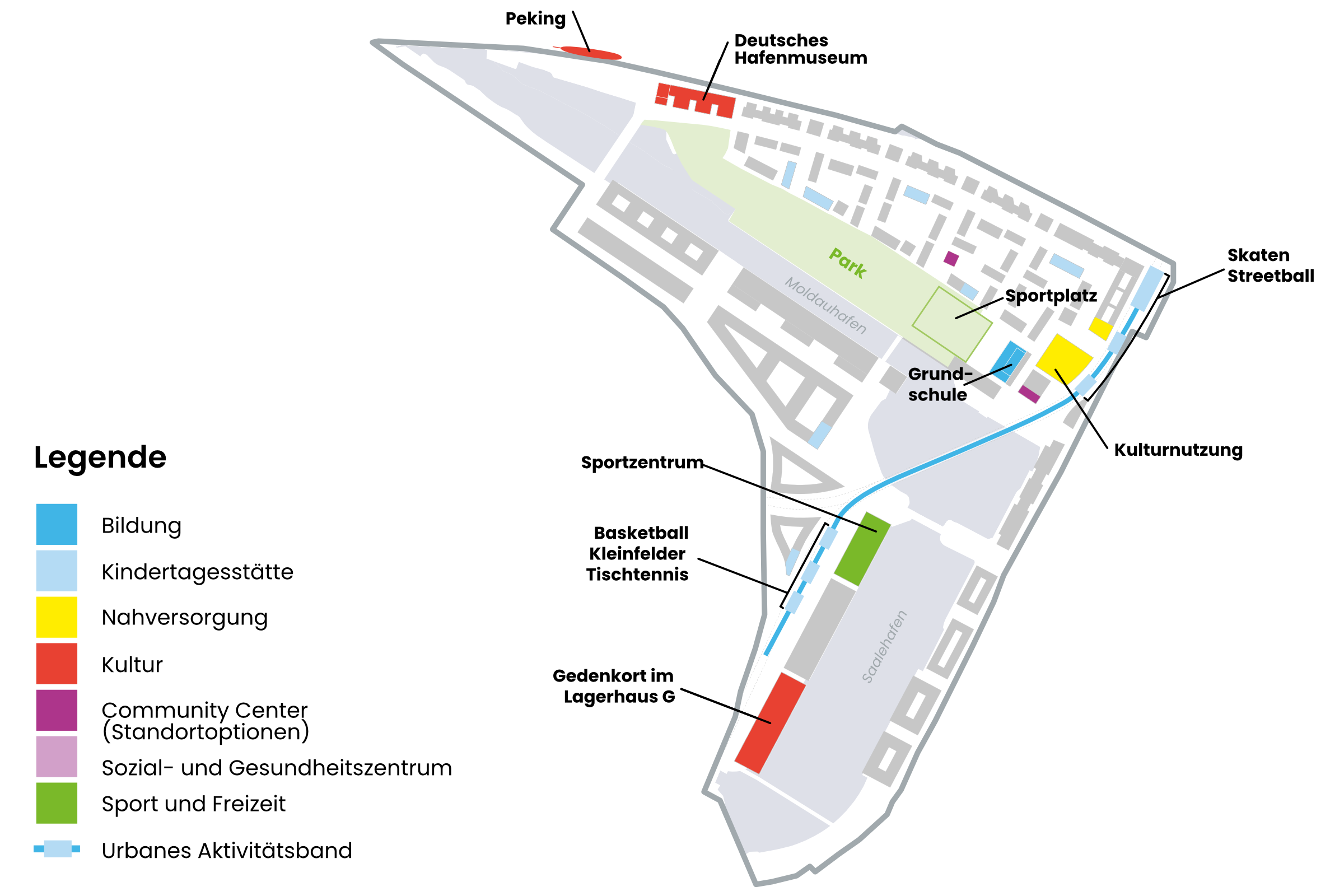
Education, Neighborhood, Culture, and Local Services at Grasbrook
© büro luchterhandt & partner
Urban development
The center around the Moldauhafen connects the two quarters of the district, the Moldauhafenquartier with a residential focus and the commercially characterized Hafentorquartier
Open spaces
A large park in the middle of the district, squares, promenades and wild green riverside zones create a variety of open space qualities
Mobility
A new subway station and a dense network of pedestrian and cycle paths make the use of private cars superfluous in Grasbrook
Sustainability
Key areas of focus in neighborhood development include the use of renewable energy, the responsible use of resources, and construction standards