

Sustainability concept
© moka-studio GbR
Sustainable city
Because of its location on the Elbe Island, issues such as flood protection, climate adaptation, energy supply, and resource use are already being taken into account in the planning for Grasbrook.
Flood protection, stormwater management, architecture, energy supply, infrastructure, and communications technology are incorporated into the planning process from the very beginning.
Grasbrook is to be developed as a model neighborhood for resource management and greenhouse gas emissions. The measures planned for this purpose include, among other things, buildings, open spaces, infrastructure, and mobility.
CO2 Emissions and Resource Requirements
Circular construction methods are planned for the new buildings to account for the use of materials throughout their entire life cycle. In addition to the buildings, the carbon footprint of structures such as bridges, waterfronts, promenades, and roads will also be monitored. A carbon and resource management system is intended to support the tracking and assessment of material use and greenhouse gas emissions.
Opportunities to reduce greenhouse gas emissions are also being considered in the areas of energy supply and mobility. As a result, Grasbrook is consistently being developed into a low-traffic neighborhood, where bus and rail services, cycling, and walking form a central focus of the mobility plan.
Renewable Energy
Grasbrook’s energy supply is aligned with the goals of the energy transition and the guidelines of Hamburg’s Climate Plan. The plan calls for an energy supply that incorporates renewable energy sources and takes the neighborhood’s needs into account. A large portion of this energy is to be generated on-site—for example, through geothermal heat and solar panels on the rooftops of the buildings and the large “roof.” Additional demand will be met through public utility grids.
The buildings are designed to take their heating and cooling needs into account. They are connected to each other via a heating and cooling network and are supplied with, for example, waste heat or ambient heat.
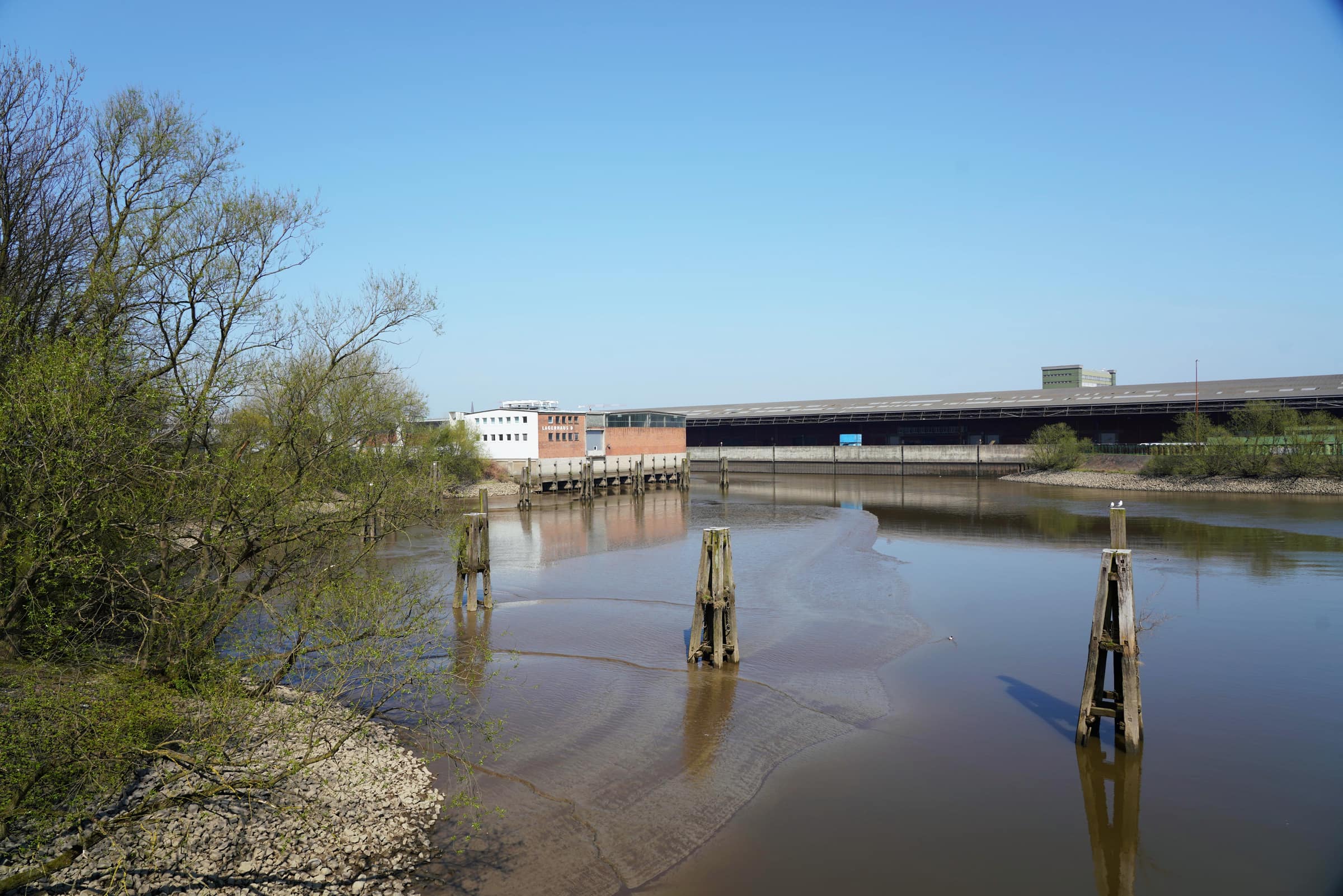
Freshwater mudflats and ruderal vegetation at Moldauhafen © Thomas Hampel
Open Spaces, Biodiversity, and Urban Nature
Grasbrook is being developed on a site that has been optimized for port operations over the past few decades. To achieve this, bodies of water were filled in to create large and almost entirely impervious logistics areas, which were bounded by quay walls and rock fill. However, as port operations gradually declined, nature was able to reclaim parts of the area. Along disused freight tracks and silted-up areas in the “ Moldauhafen ” and “ Saalehafen ”—with their freshwater mudflats—riparian zones with various forms of spontaneous vegetation have developed.
The new Grasbrook builds on what already exists, reopens large areas to nature, and creates new parks and green spaces. It leaves the bodies of water intact and, by partially removing the quay walls, creates new connections to the water. Existing habitats are to be preserved and enhanced. The goal is to support the diversity of plant and animal species in the neighborhood. The green-lined streets and buildings with their green roofs and vegetated facades also contribute to this.
"Sponge City": Integration of Water Cycles
The impacts of climate change—such as extreme weather and heavy rainfall events, heat stress, and drinking water shortages—also play a role in the planning of Grasbrook. Decentralized and nature-based stormwater management is intended to contribute to the vegetation’s water supply in the long term. The goal is to retain and store stormwater and use it for irrigation.
Thanks to its dual waterfront location along the Elbe and the adjacent harbor basins Moldauhafen and Saalehafen , Grasbrook is well-positioned to handle heavy rainfall events. Nevertheless, for the street trees as well as the parks and green spaces, the plan is to keep stormwater within the neighborhood’s water cycle as much as possible rather than discharging it directly into the Elbe.
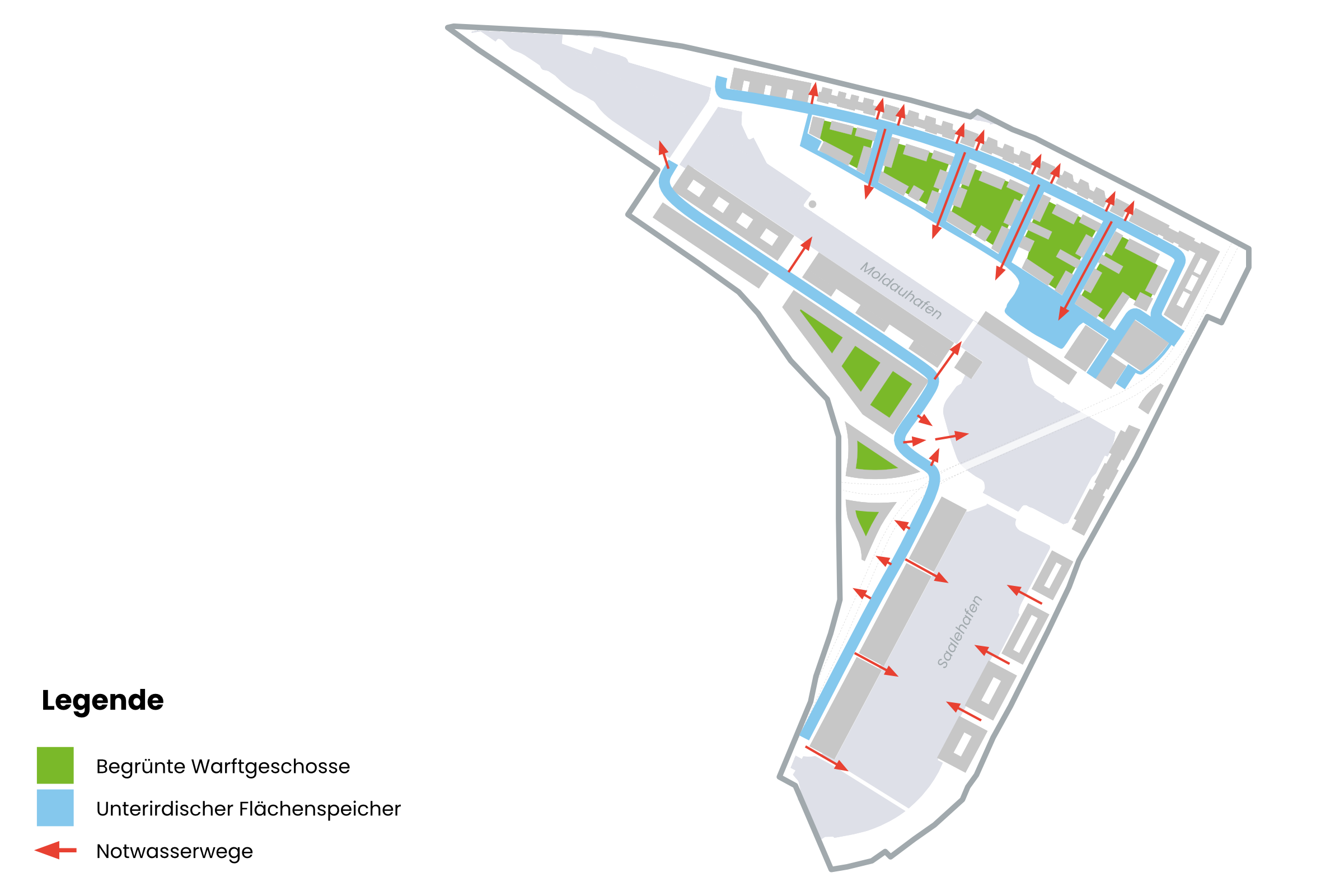
Urban stormwater management © büro luchterhandt & partner
In addition to the green roofs and façades of the buildings, decentralized stormwater management also includes the green residential courtyards, in which rainwater is retained and stored above the mound level and used for irrigation on the construction sites. The drainage of the public street areas, especially on Grasbrook Boulevard, is carried out without traditional stormwater pipes. The rainwater is directed into the green strips planted with trees, seeps away and remains available in the existing soil layers to water the trees.
The concept of urban stormwater management thus follows the principles of Sponge City: rainwater is gathered, stored and released again as required. This makes it possible to dispense with sieve systems with pipes, shafts and discharge structures. In addition, the aim is to use graywater to save drinking water in building services.
Urban development
The center around the Moldauhafen connects the two quarters of the district, the Moldauhafenquartier with a residential focus and the commercially characterized Hafentorquartier
Open spaces
A large park in the middle of the district, squares, promenades and wild green riverside zones create a variety of open space qualities
Uses
A district for everyone is being created in Grasbrook, with apartments, workplaces and many cultural, educational and leisure facilities
Mobility
A new subway station and a dense network of pedestrian and cycle paths make the use of private cars superfluous in Grasbrook