

Urban planning concept
© VOGT Landschaftsarchitekten
Neighborhoods grow together
The port is making way for the new Grasbrook district. At the same time, it is continuing to develop and, as a universal port, is opening up to further modern port-related commercial activities. In the future, the city and port will therefore be directly adjacent to each other. This neighborhood will be used for mutual synergies and provide important impetus for new urban commerce. The immediate proximity to Veddel, HafenCity and Rothenburgsort also offers special conditions for Grasbrook.
Wide traffic routes, the Elbe stream and several harbor basins are still barriers that separate the new district from the neighboring districts of Veddel, Rothenburgsort and HafenCity. In addition, the long-neglected districts of Veddel, Rothenburgsort and the northern part of Wilhelmsburg lack many amenities.
Grasbrook is therefore being planned in such a way that its surroundings also benefit from the new facilities. Many jobs will be created in Grasbrook for people with vastly different qualifications – within easy reach for the residents of Grasbrook, but also of Veddel and other neighboring districts.
The proximity to the Elbe
The Elbe and the Port of Hamburg are subject to alternating high and low tides with a tidal range of around 3.70 meters. Grasbrook is located in an area of the Elbe that is at risk from storm surges. Flood protection for Grasbrook will be based on the "dwelling mound concept" concept already tried and tested in HafenCity: The new buildings will be erected on mounds, i.e. on a raised base that offers space for parking and mobility options, for example.
Almost the entire district will be raised by 5 meters compared to the current ground level. Only the promenades will remain at the old level. The new flood protection level in the district will then be 9.70 meters above sea level, taking into account the forecasts for rising sea levels and increasing flood risks over the next 120 years.
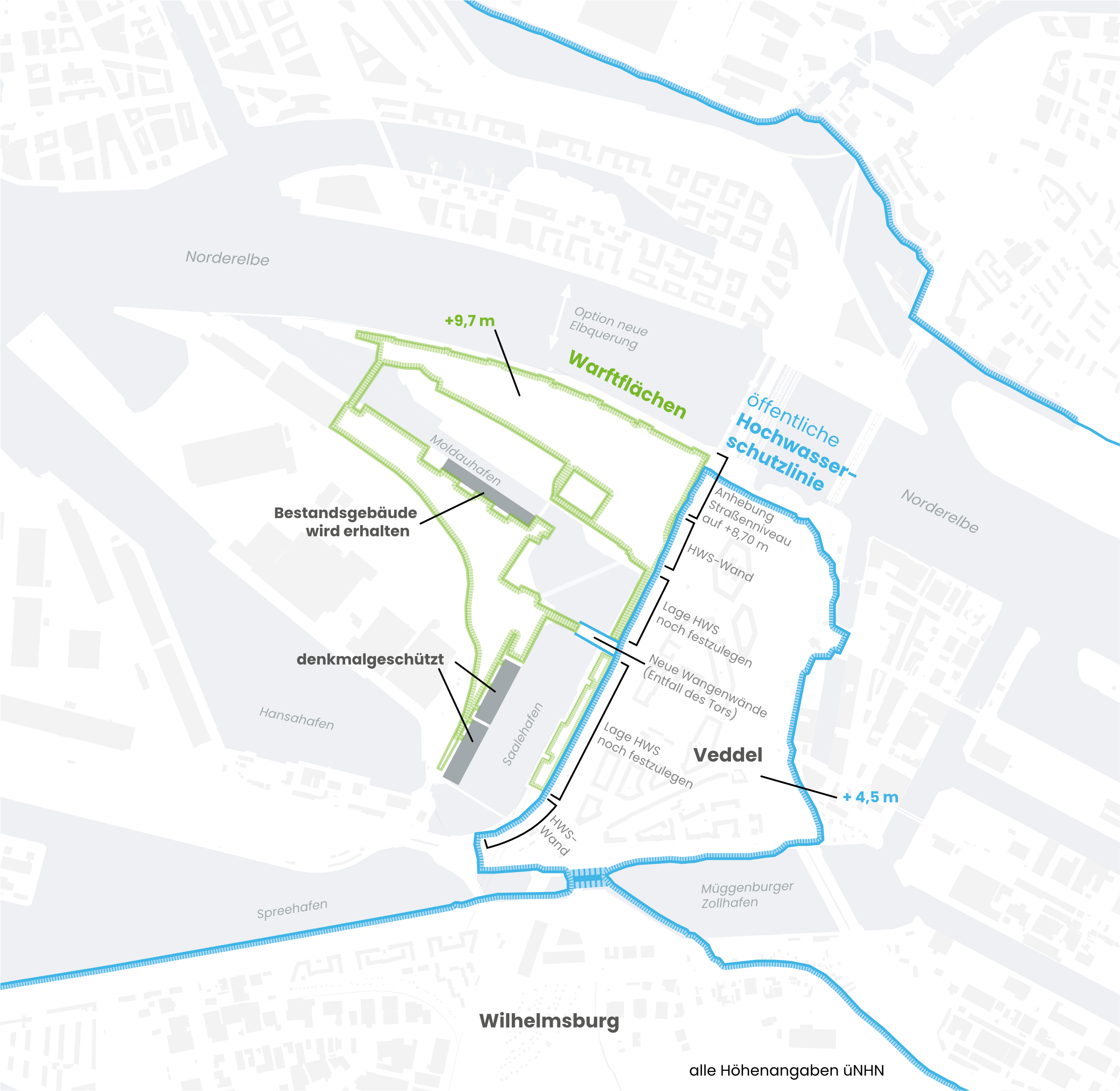
Private and public flood protection in Grasbrook and Veddel © büro luchterhandt & partner
One district – two quarters
The heart of the new Grasbrook district is in its center, at the almost square-shaped Moldauhafen. This is where the new U4 subway station and the city square with central facilities such as an elementary school, retail outlets and restaurants are built. A wide new bridge for pedestrians and cyclists leads from the city square to Veddel and connects it to the subway.
The new U4 station floats above the Moldauhafen and the Hafenbeckenpark surrounding the water. Three striking 20-story high-rises mark the center of Grasbrook as a group of three individual buildings of equal height. This center around the Moldauhafen connects the two quarters of the new district: the northern Moldauhafenquartier with its residential focus and the commercial Hafentorquartier in the south.
© moka-studio GbR
Moldauhafenquartier
The Moldauhafenquartier is located on a peninsula between the Elbe and Moldauhafen. In the direct vicinity of Veddel, it forms the "residential quarter" in the new district. With stores, cafés, services, cultural facilities, social infrastructure and sports facilities, the district has a very lively character. At the same time, it is characterized by varied green spaces, squares and waterfront locations. In terms of urban development, different sub-areas with a high recognition value arise in the Moldauhafenquartier.
The district entrance at the Elbbrücken
The district entrance at the Elbbrücken forms a metropolitan portal to the new Grasbrook district. In the north-east of the district, the development is primarily intended for office use due to the traffic noise from the Elbbrücken. A combination of half-timbering and up to 11-story high rises creates the necessary noise buffer to the residential use behind it. The entrances to the underground delivery zones and neighborhood garages are integrated into this development, allowing the Moldauhafenquartier to remain largely car-free.
The city square as an urban center
Most residents, employees and visitors arrive at the centrally located city square – by subway, on foot or by bike via the new Veddel Bridge. The city square will become a place of arrival and the urban center of Grasbrook and Veddel. On the south side of the square, a spacious staircase leads down to Moldauhafenbecken with its tidal water. From the square, a central urban axis opens up to the large "roof" and through the central park to the western headland at Veddelhöft. The newly built roof is reminiscent of the impressive pent roof of the former Überseezentrum (overseas center) from the 1960s. The covered open space represents a special public meeting place, the effect of which will radiate to the neighboring Veddel and beyond.
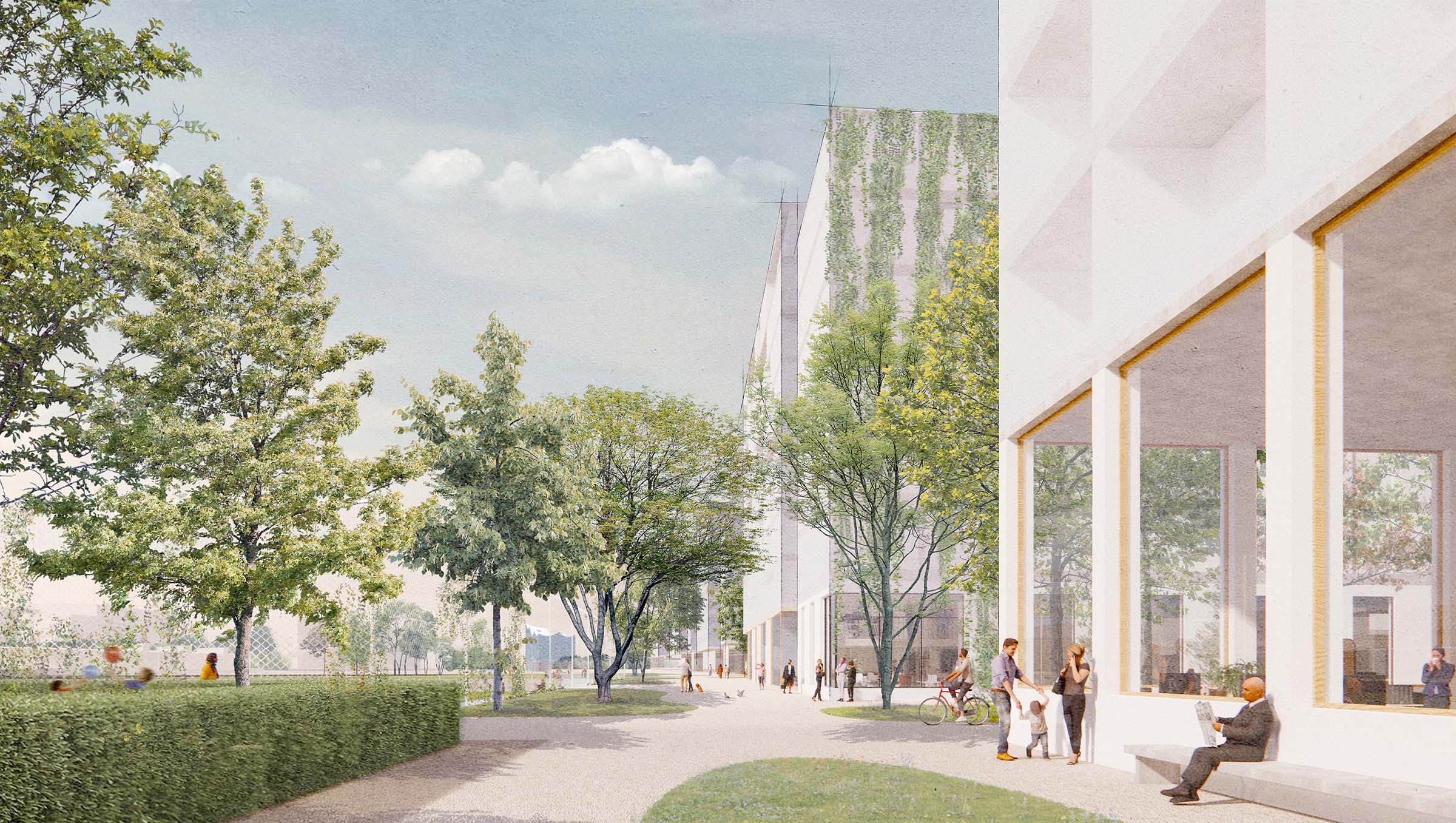
Along the park promenade © Herzog & de Meuron, VOGT Landschaftsarchitekten
The central park with the residential islands
The park, which is particularly spacious at five hectares, underscores the importance of the open spaces for the entire new neighborhood. Its size also means that development in the Moldauhafen quarter is concentrated along the banks of the Elbe and at the entrance to the neighborhood. North of the park are the five so-called “residential islands”: 7- to 12-story residential buildings arranged in an open perimeter block layout. The residential islands vary in size depending on their location and feature a wide variety of building typologies. The goal is a design that incorporates large, green residential courtyards and opens up toward the park.
Striking residential buildings on the banks of the Elbe
The second residential focus is the "north edge", a long row of residential buildings on the water's edge to the Norderelbe. With its alternation of tower blocks and half-timbering, north edge creates a striking silhouette by the Elbe and towards the opposite HafenCity. Between the northern edge and the residential islands, in the east-west direction of the Elbe, is Grasbrook Boulevard, which is designed as a cycle route and for public transport. Green axes cross the boulevard in a north-south direction and provide good pathways in the quarter.
© moka-studio GbR
Hafentorquartier
The Hafentorquartier is located to the south of the Moldauhafen and west of the Saalehafen. Right next to the O'Swaldkai terminal, which will continue to be used for traditional cargo handling operations, a sustainable commercial site is being created with a variety of building typologies for research and development, digital companies, services and urban production. Most of the targeted 16,000 jobs in Grasbrook will be created in the Hafentorquartier.
The Hafentorquartier is divided into a northern part with the so-called "Bananenreiferei" (ripening facility), the area at Dessauer Straße with the historic Lagerhäuser F and G and the buildings at the eastern Saalehafen. Housing will not be possible in the Hafentorquartier as it will remain within the ambit of the port area. However, the green open spaces with their water access and sports facilities are not only available to the people who work here, but also to visitors and residents of Veddel and Moldauhafenquartier.
Sustainable business location – excellently developed and connected
In the future, anyone coming to the Hafentorquartier for work or leisure purposes will use the U4 station located diagonally across the harbor basin or walk or cycle via the new Moldauhafenbrücke in the western part of Grasbrook. As before, the redesigned Sachsenbrücke will also serve car traffic. At the same time, the Sachsenbrücke will ensure efficient access for commercial and freight traffic.
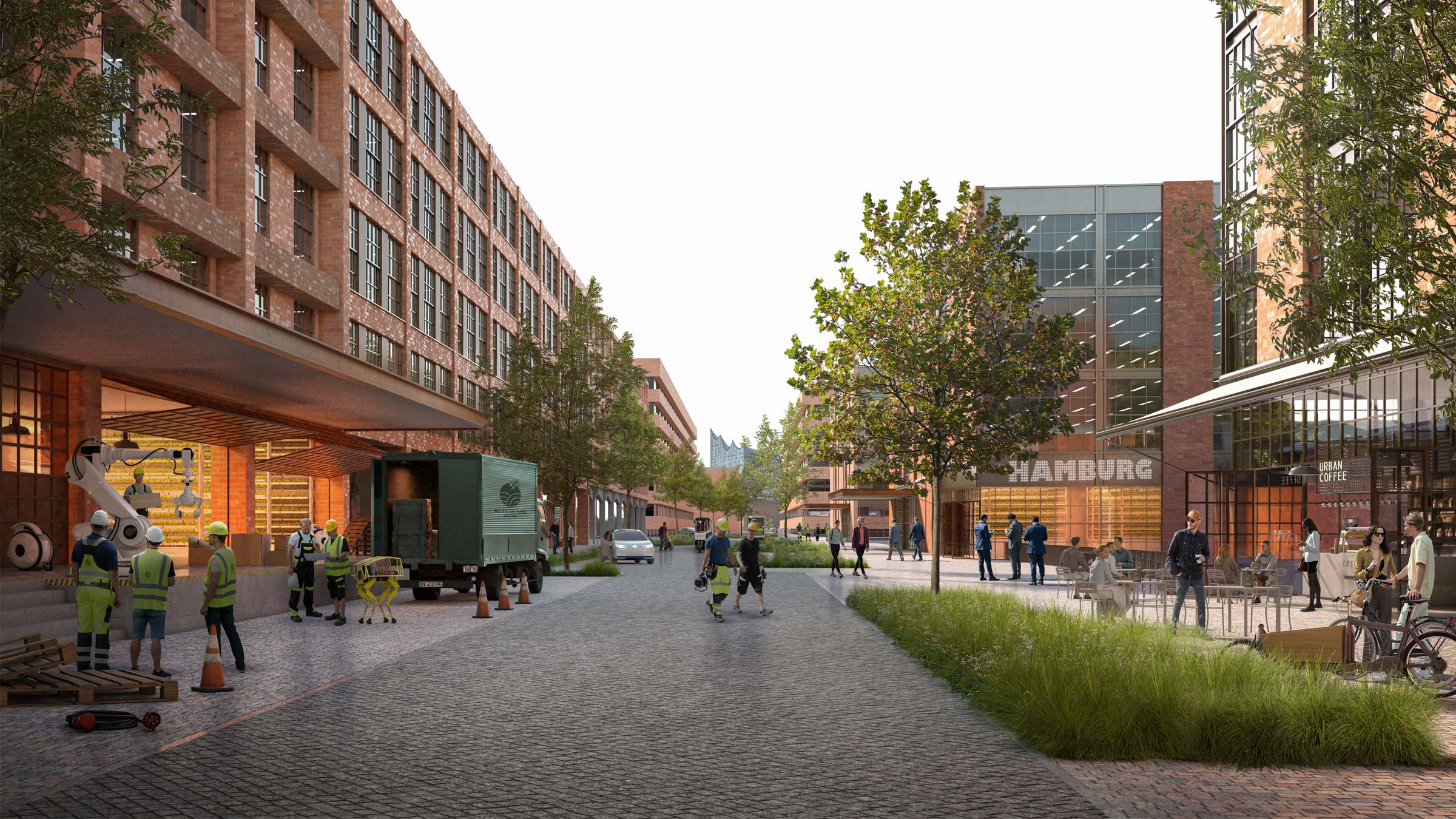
Hafen Boulevard © moka-studio GbR
Listed warehouses as new locations for modern working environments
A 20-story high-rise forms the prelude to the sub-area at Dessauer Straße. The area is characterized by its mixture of listed historic warehouse buildings and new buildings. A long, park-like green corridor along the warehouses gives the urban space a green character and offers opportunities for sports and play facilities.
Three listed warehouses at the Moldauhafen ("Bananenreiferei") and Saalehafen (Lagerhäuser F and G) are models for the new buildings in the quarter due to their impressive size and building density. The large building volumes of both the existing and the new buildings allow for a high degree of flexibility of use in their interiors. Diverse working environments can coexist here.
On the east side of the Saalehafen (Hallesches und Dresdner Ufer), a building edge forms the opposite side of the historic warehouses. Four buildings will be erected there on the narrow strip between the shore and the busy harbor traffic road behind it. A promenade runs directly along the shore and connects this part of the quarter with the Hafenbeckenpark.
Busy ground floor and public spaces
Given the predominantly commercial use of the Hafentorquartier, busy ground floors and offerings in the public space are particularly important to ensure that the quarters are lively in the evenings and at weekends too. For the ground floors, functions that give resident companies visibility in the urban space are planned – such as showrooms, exhibition and sales areas or canteens.
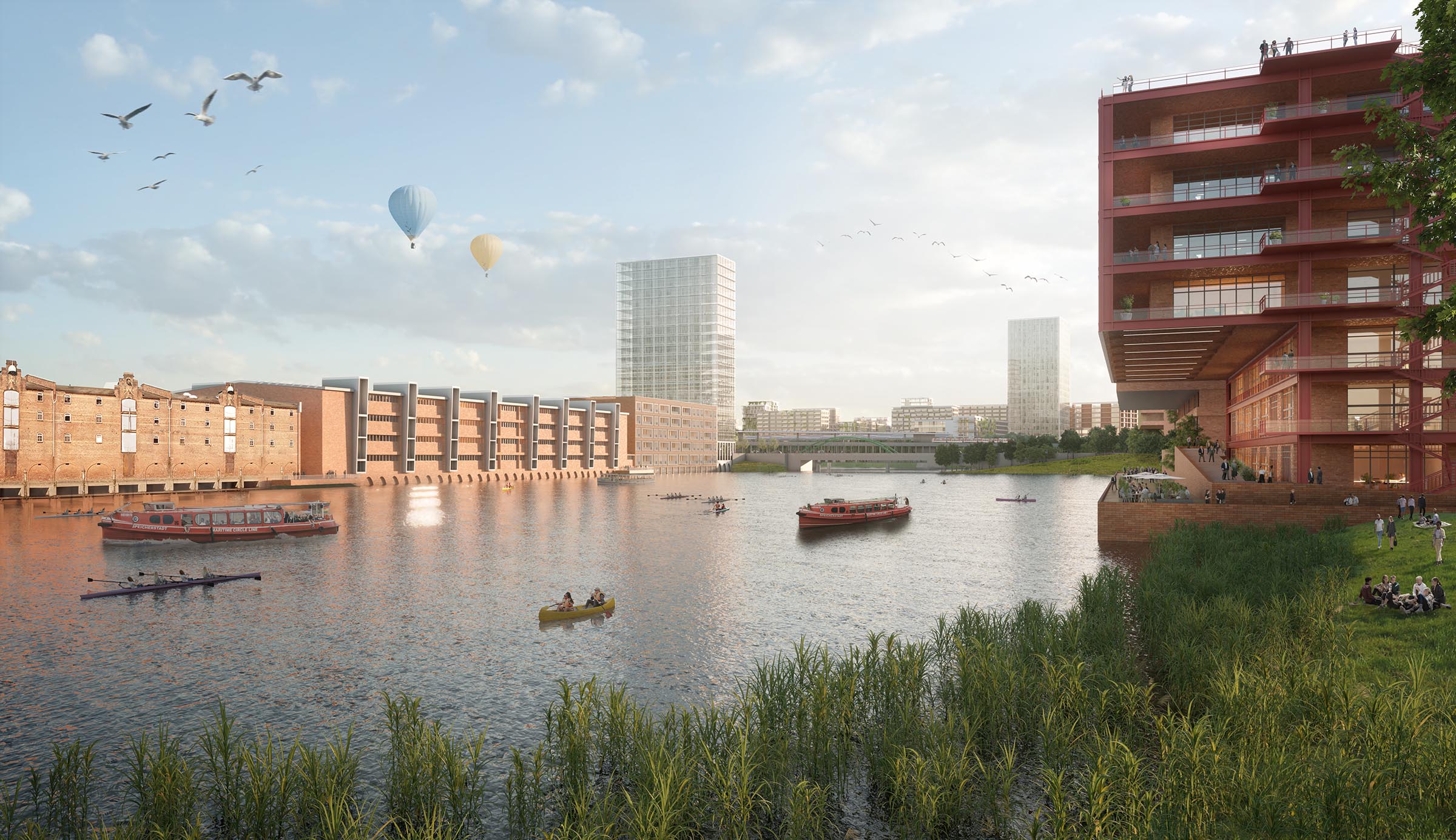
New working environments in the Hafentorquartier © moka-studio GbR
Open spaces
A large park in the middle of the district, squares, promenades and wild green riverside zones create a variety of open space qualities
Uses
A district for everyone is being created in Grasbrook, with apartments, workplaces and many cultural, educational and leisure facilities
Mobility
A new subway station and a dense network of pedestrian and cycle paths make the use of private cars superfluous in Grasbrook
Sustainability
Key areas of focus in neighborhood development include the use of renewable energy, the responsible use of resources, and construction standards