

Mobility concept
© Herzog & de Meuron
Short distances
In urban planning today, the ideal of the "10-minute city" is groundbreaking. This refers to a city of short distances, in which people can do everything important on their doorstep - within 10 minutes on foot or by bicycle. This concept is being taken a step further on Grasbrook: from the central town square, almost every place in the district and a large part of Veddel can be reached on foot in 5 to 10 minutes.
As a newly planned neighborhood, Grasbrook offers the opportunity to redesign mobility from the ground up. Thanks to short distances and good connectivity for pedestrians, cyclists, and bus and train travelers, most trips should be possible without a private car. The goal is for about 90 percent of trips to be made on foot, by bicycle, or by public transportation.
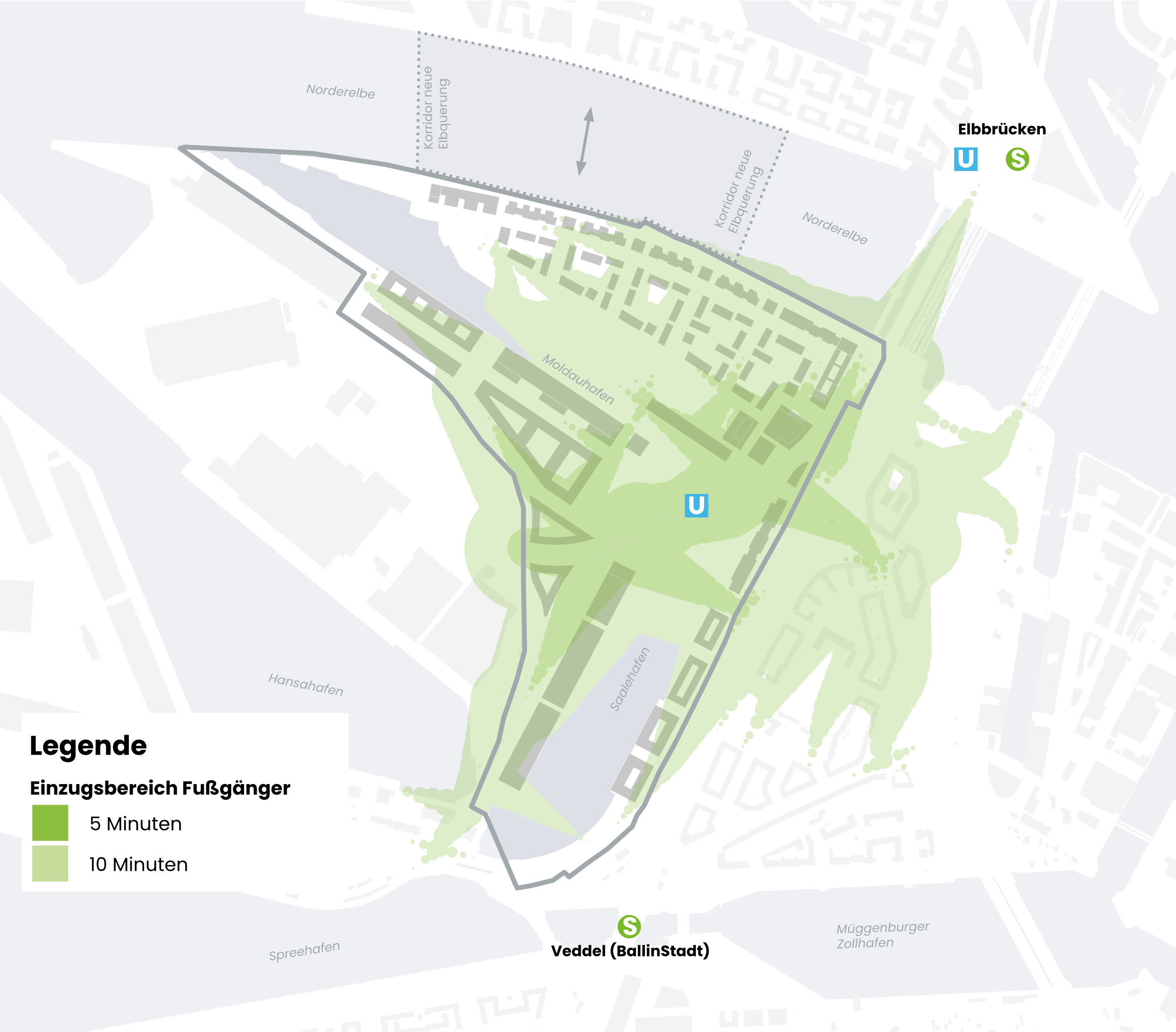
Walking distance from the platform of the new subway station
© büro luchterhandt & partner
© moka-studio GbR
Well-developed public transportation
The district’s good accessibility via public transit is a central component of the mobility concept. The goal is for people who live or work here not to rely on their own cars, but to use public transit for longer trips. Accordingly, a key component is the extension of the U4 subway line from its current terminus at “ Elbbrücken ” to Grasbrook. The subway station will be built in the center of the new neighborhood and—uniquely in Hamburg—will “float” on stilts in the waters of the Moldauhafen basin. The “ Veddel ” will also benefit from direct access from the “ Veddel ” bridge to the U4 station.
In June 2023, the result of an interdisciplinary realization competition for the new U4 bridge and station was presented to the public. A consortium consisting of schlaich bergermann partner sbp SE (Stuttgart), gmp Architekten von Gerkan, Marg und Partner (Hamburg) and WTM Engineers GmbH (Hamburg) won the competition. In the future, the U4 is to be extended further south towards Wilhelmsburg. The existing suburban train stations Elbbrücken and Veddel are also within easy walking distance of Grasbrook.
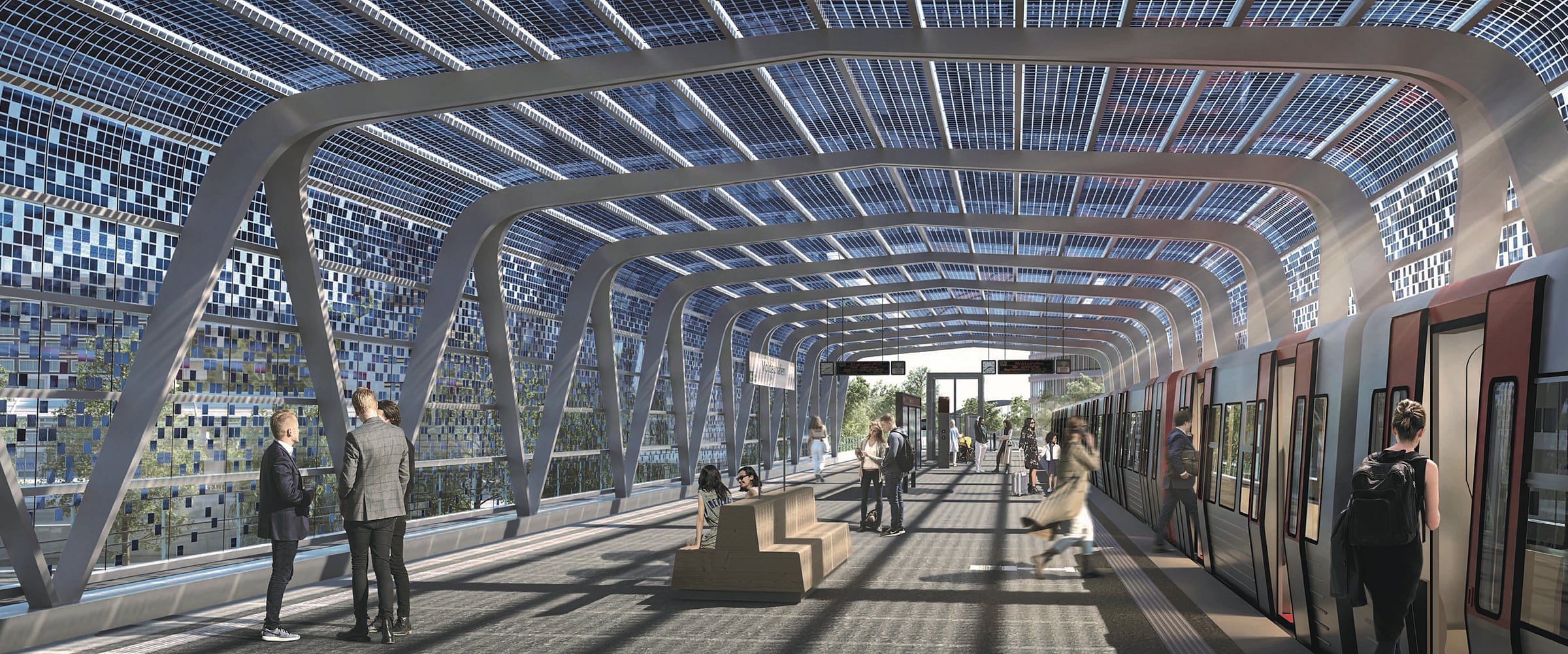
The U4 subway line will be extended to Grasbrook © HOCHBAHN / moka-studio GbR
A new ferry pier is to be built on the banks of the Elbe about halfway between the German Harbour Museum in the west of the district and Elbbrücken , which will enable a quick crossing of the Elbe. New bus routes and stops will better connect Grasbrook and Veddel with Rothenburgsort, HafenCity and Wilhelmsburg. Bus shuttles - possibly autonomous - will operate within the new district. These are particularly helpful for people with limited mobility in everyday life.
It is currently being examined whether an additional new bridge can be built as a direct link to HafenCity. If it is built, it would be primarily intended for pedestrians and cyclists, but would also enable an extension of the shuttle service across the Elbe.
Of course, there will also be various sharing offers on Grasbrook - such as car sharing or rental bikes. Depending on the occasion and requirements, these will enable people to switch between different mobility options and contribute to the functioning of the low-car district.
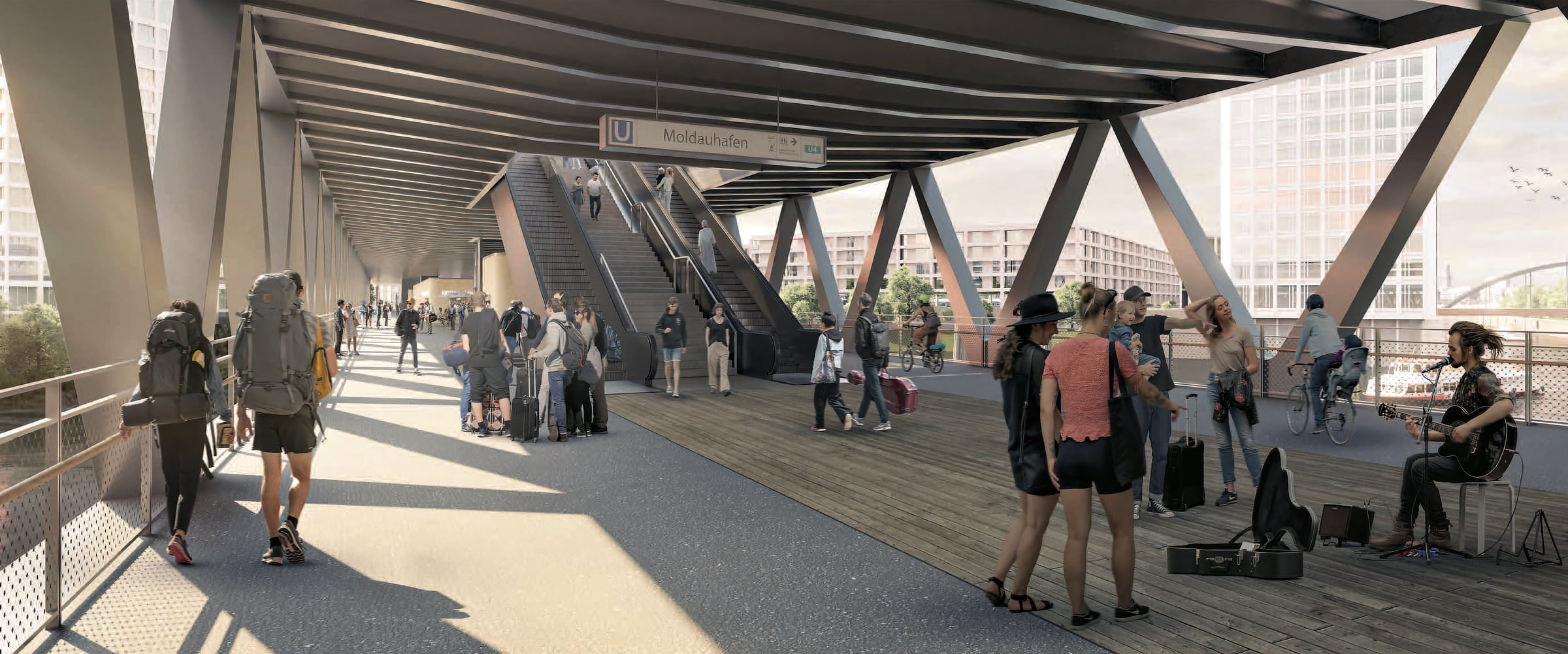
The subway station Moldauhafen © HOCHBAHN / moka-studio GbR
The street becomes a social urban space
In Grasbrook, the "street" becomes a place to meet and spend time and no longer serves solely as a functional traffic and pathway area.
In order to make the pedestrian and cycle paths in the district as attractive and safe as possible and to give the public space a high quality of stay, cars are largely kept out of Grasbrook. This Moldauhafenquartier will become a car-free district. The main access road there, Grasbrook Boulevard, will also remain largely free of moving and parked cars. Parking spaces will only be provided in three underground garages on the terp floors. With a maximum of 0.2 parking spaces per apartment, the parking space ratio has been deliberately kept very low.
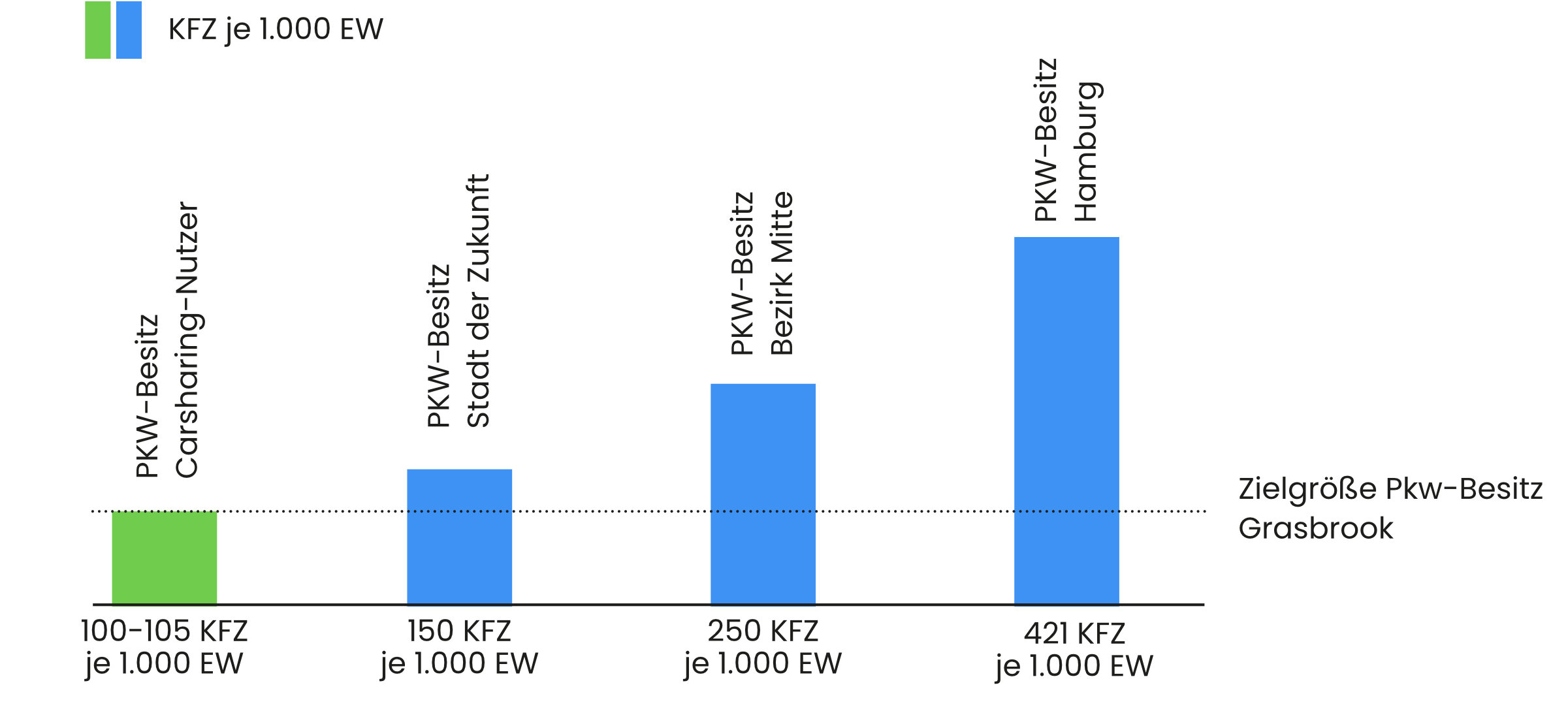
Target figure for private car ownership in Grasbrook in comparison
@ ARGUS Stadt und Verkehr
Grasbrook Boulevard as a cycle lane
The entrances to the central underground parking garages are located at the entrance to the district, where the two planned supermarkets are also located. Most of the boulevard will be designed as a traffic-calmed and landscaped bicycle lane with spacious pedestrian areas. Delivery traffic for the people living in the district and for the offices, stores and cafés there will also be handled either by cargo bike or also underground in the specially designated loading zones on the terp floors.
Decentralized underground car parks in the Hafentorquartier
In the commercially characterized Hafentorquartierthe situation is different. Here, large parts of the quarter are accessible by car or truck. However, transit traffic – for example from the northern entrance at the Sachsenbrücke to the southern entrance at the Dessauer Straße or via the Moldauhafenbrücke into the residential area - is not planned. Large parts of the Dessauer Straße will be transformed into a linear park with sports and leisure facilities.
Employees, suppliers and customers who do not come to Hafentorquartier by public transport, bicycle or on foot, but in their own car, will find a reduced number of parking spaces in the decentralized underground garages (terp levels) of the respective buildings. Delivery traffic and logistics requirements with lorry loading yards and turning facilities are realized on the properties themselves, so that the street spaces can be designed with a high quality of stay.
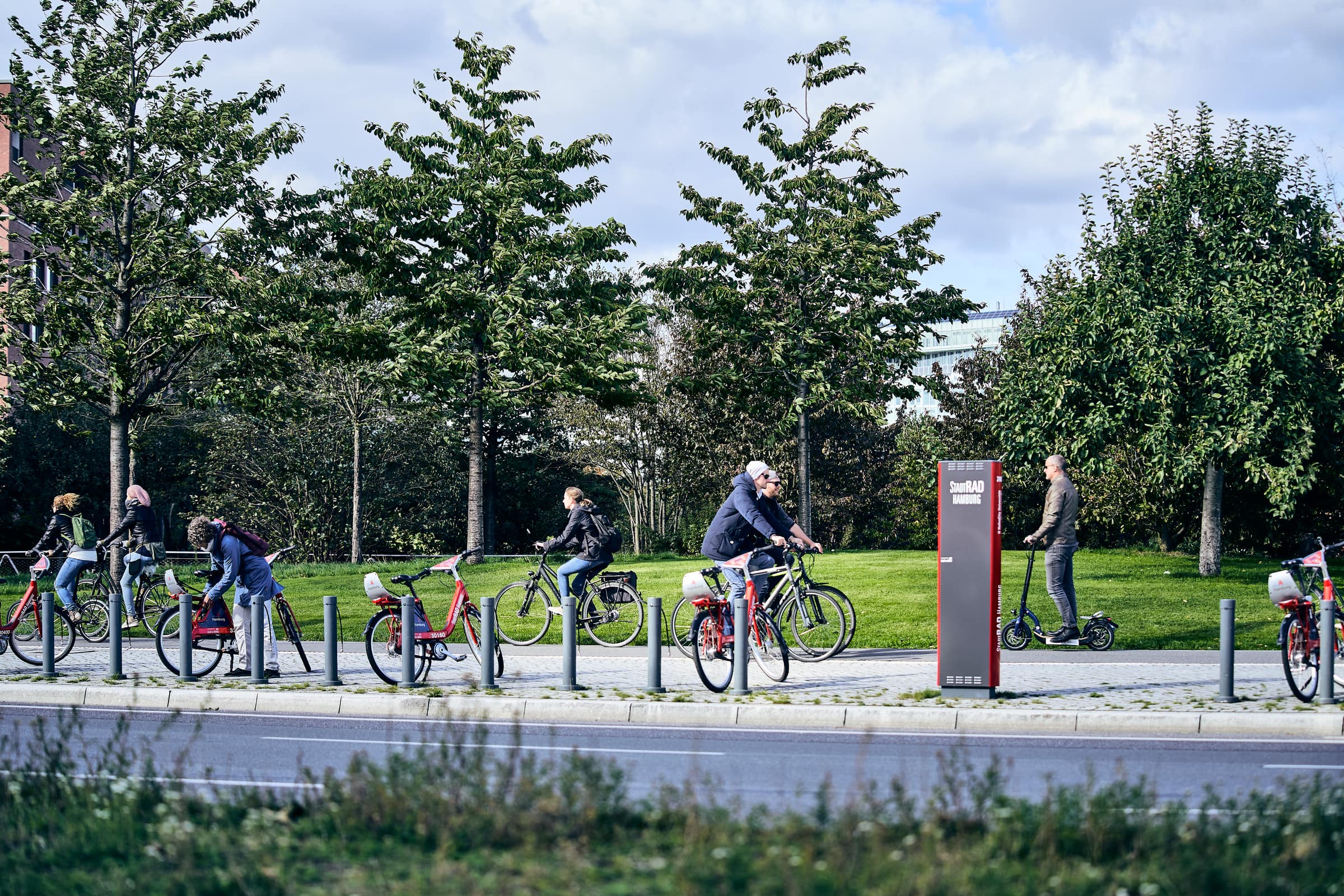
StadtRad station at Lohsepark in HafenCity © Stephan Groenveld
Footpath and cycle path network
Grasbrook is becoming a district for pedestrians and cyclists. Therefore, high demands are placed on the quality of the pedestrian and cycle paths and the bridges over the harbor basins and traffic routes. The most important cycle connections run along the Moldauhafenquartier via Grasbrook Boulevard and the Hafentorquartier via the Sachsenbrücke, along the border to the port area (O'Swaldkai Terminal). Via the Moldauhafenbrücke, the route could continue via a possible new Elbe crossing directly into HafenCity and Hamburg city center.
For cyclists, the connection to the higher-level cycle path network (e.g. cycle route 10) is via Elbbrücken between Veddel and Rothenburgsort. These main routes are supplemented by a subordinate network of paths along the Elbpromenade, through the central park and the green corridor on Dessauer Straße. To reduce conflicts between the various users, pedestrians have priority here. There are also paths that are reserved for pedestrians – for example along the park, in the Hafenbeckenpark, on the promenade at Moldauhafen or the green corridors between the residential islands.
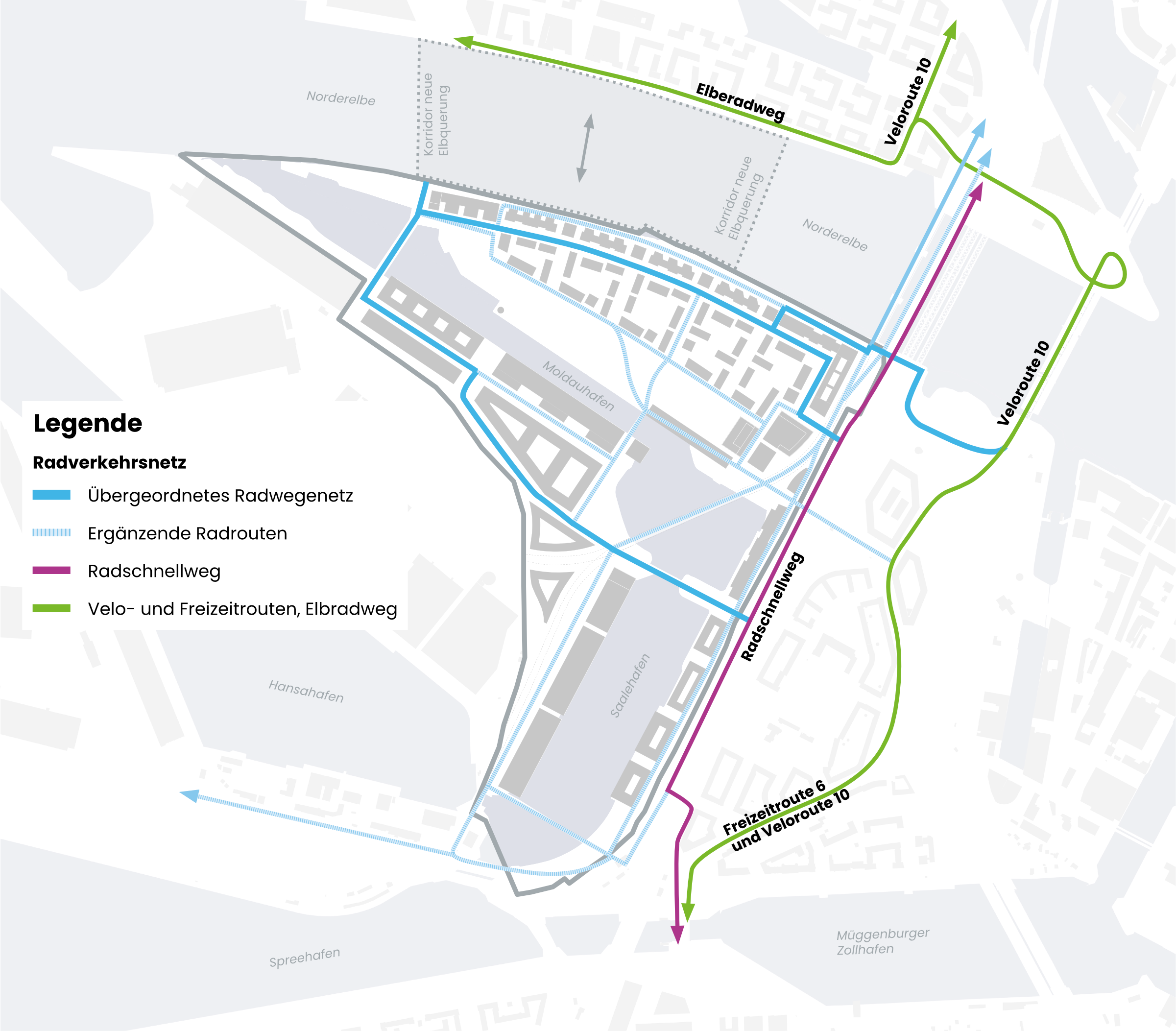
The dense cycling network in Grasbrook. © büro luchterhandt & partner
Mobility hubs for Grasbrook
At Moldauhafenquartier , "mobility foyers" play an important role in the mobility concept. They serve as a central point of contact for everyday logistics and mobility needs. Located on the first floors of the "residential islands" and the commercial buildings at the entrance to the district and on the district square, they are also the visible symbol of the mobility turnaround on Grasbrook.
In addition to functions such as parcel stations, the rental of cargo bikes and e-scooters, shower and changing facilities for cyclists and exchange racks, bicycle repair stations and other services can be offered there. In addition, access to the car-sharing parking spaces, delivery zones and parking facilities for vans on the mezzanine floor below the buildings can be accessed from here.
Urban development
The center around the Moldauhafen connects the two quarters of the district, the Moldauhafenquartier with a residential focus and the commercially characterized Hafentorquartier
Uses
A district for everyone is being created in Grasbrook, with apartments, workplaces and many cultural, educational and leisure facilities
Open spaces
A large park in the middle of the district, squares, promenades and wild green riverside zones create a variety of open space qualities
Sustainability
Key areas of focus in neighborhood development include the use of renewable energy, the responsible use of resources, and construction standards