

Open space concept
© Herzog & de Meuron, VOGT Landschaftsarchitekten
City by the Water
For many city dwellers, the quality of life in their district depends not least on the attractiveness of the parks, squares and other open spaces in their neighborhood: the higher the quality of the open spaces, the more liveable the district. There is often a lack of high-quality open spaces, especially in densely built-up inner-city districts. This is set to change in Grasbrook.
Even in the first sketches by the planning teams for the competitive dialogue, the high importance of open spaces was evident – despite the limited space on the elongated peninsula between the banks of the Elbe and Moldauhafen. In the approved functional and open space planning, a whole series of small and large parks and green spaces will characterize the district and can be designed and used in a variety of ways.
A special component of the varied green space system are the existing places of urban nature with their freshwater mudflats in the Moldau- and Saalehafen, "wild" green shore zones and small woods, where nature has reclaimed areas formerly used for port operations.
The diverse open spaces provide opportunities for recreation, sports, and social interaction. At the same time, with their high proportion of unpaved areas, they play an important role in the urban climate and stormwater management.
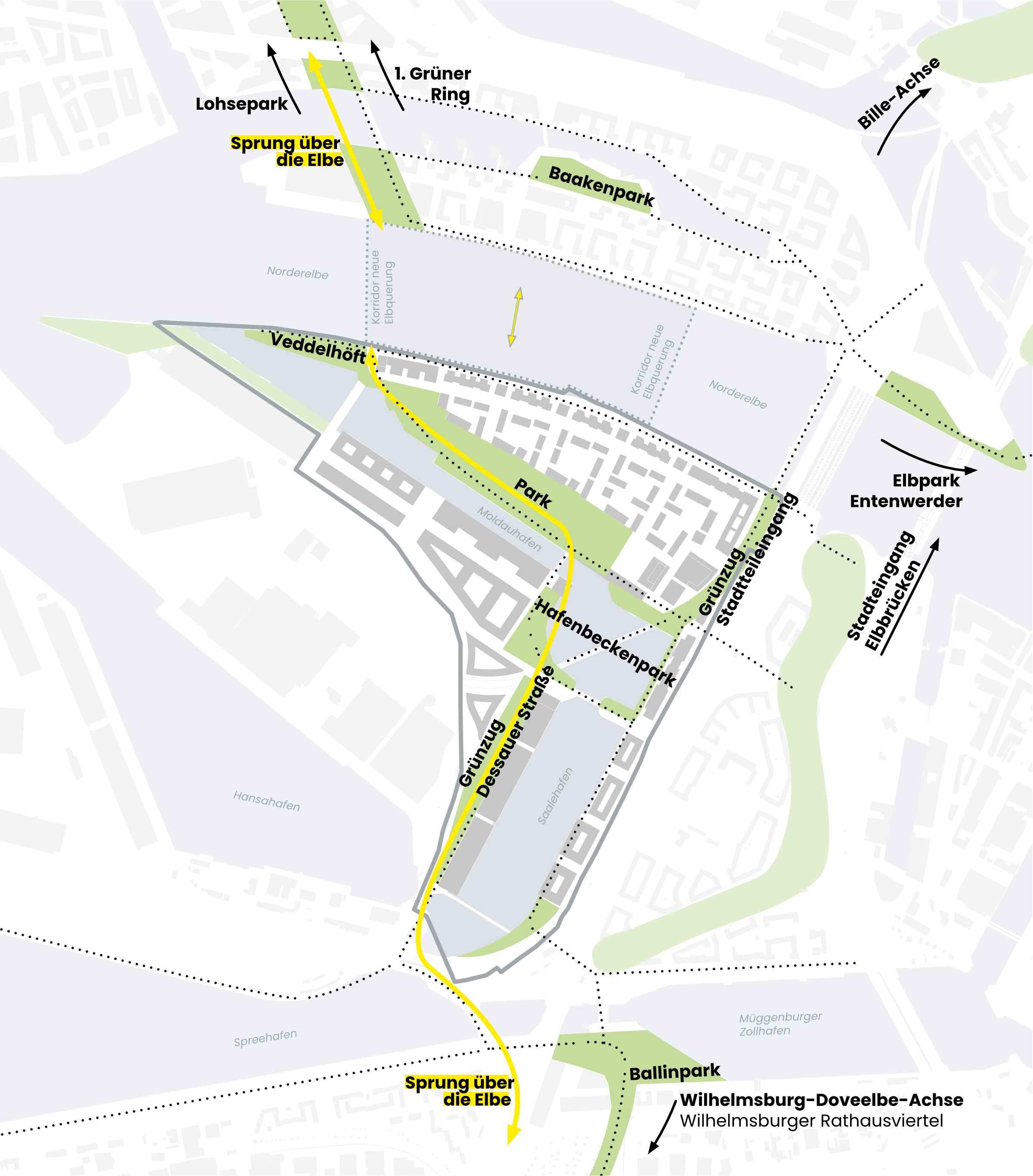
The public open spaces in Grasbrook and their interconnectedness © büro luchterhandt & partner
Green or urban: diverse spaces for the new district
The most important and largest square is the central city square at the entrance to the district with the subway station, many local amenities and a high sojourn quality right on the waterfront. There is also the forecourt of the German Port Museum, the riverside square at the ferry pier in the far west of Grasbrook and a large neighborhood square in the Hafentorquartier at the entrance to the U4 station. The four large squares are complemented by a large number of smaller neighborhood squares. Depending on their location and use, they all tend to be green or urban and therefore look different on the Elbe or in the parks than in the area of the harbor basins and the historic warehouses.
Riverside paths and promenades along the Elbe and harbor basins
In the Moldauhafenquartier, the promenades on the banks of the Elbe and along the Moldauhafen will become attractive waterfront paths, often with sweeping views as far as the Elbphilharmonie concert hall and the backdrop of HafenCity. The promenades are crucial for pedestrians and cyclists and also offer space for sporting activities. The new embankments are a special feature of Grasbrook: Where previously high walls blocked the view of the water and hard stone rubble formed the banks, "soft" banks are now being created and made accessible with paths close to the banks or – as at the city square – with steps. This allows people to experience the changing water levels of the Elbe and the mudflats .
© Herzog & de Meuron, VOGT Landschaftsarchitekten
Parks and green corridors
The largest green space will be the five-hectare central park in the Moldauhafenquartier, which stretches from the entrance to the district in the east across the northern peninsula to the headland at Veddelhöft. This park is landscaped and offers space for a variety of uses with its various sub-areas, meadows and groups of trees, shore areas, play and sports facilities.
By contrast, the Hafenbeckenpark is not a "park" in the classic sense: its center is the tide-dependent water and mudflat landscape of the square harbor basin of Moldauhafen. While valuable vegetation has developed on its southern side over the years, the northern bank is designed as a partially green recreational area by the water.
The Dessauer Straße, which is currently used exclusively as a thoroughfare for HGV traffic, will be transformed into a wide green corridor with integrated sports areas – a kind of linear park. Further green corridors link the parks, squares and residential courtyards to form a superordinate open space system. In the Moldauhafenquartier, for example, five green corridors in a north-south direction form a "green axis" and serve as pathways from bank to bank, from the Elbe to Moldauhafen.
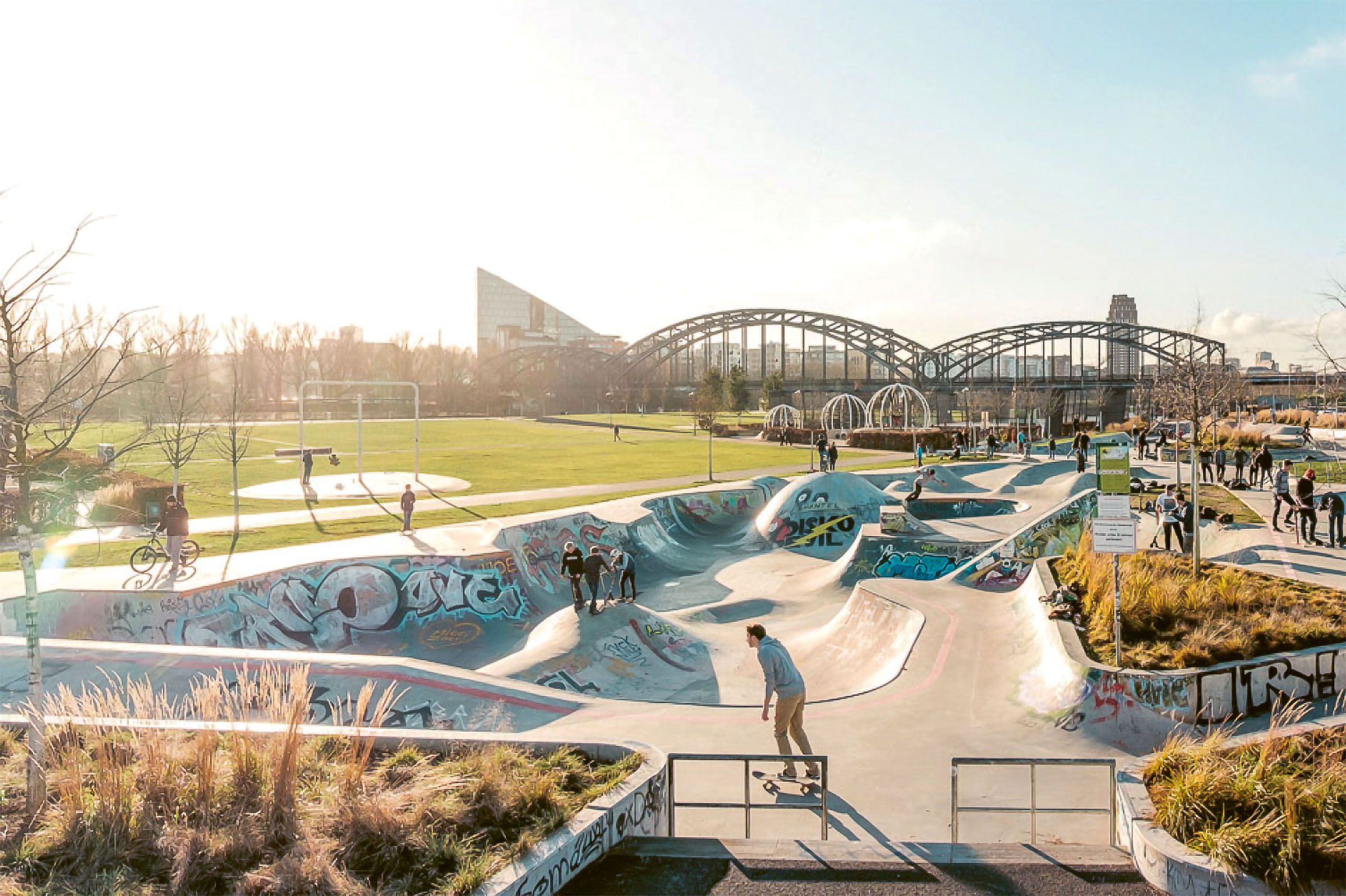
Activity bands as part of a diverse range of leisure activities © Nikolai Benner
Games, sports and leisure activities
There is a wide variety of playgrounds and open play areas in the parks and green spaces, on the promenades or under the large roof. In addition, areas such as the schoolyard of the elementary school and the outdoor play areas of the numerous daycare centers are available for play and exercise. Playgrounds are also provided in the courtyards of the residential islands or in the immediate vicinity of the residential buildings by the Elbe.
The sports areas, which cover about one hectare in total, are also spread across the whole of Grasbrook. These include the large sports field at the park, smaller scattered sports fields and local or linear sports facilities such as fitness equipment and jogging routes. A sports hall in the elementary school and a sports center are also to be built and can be used by sports clubs.
A special feature is the "urban activity band", a linear public open space that links Moldauhafenquartier and Hafentorquartier and connects Grasbrook with Veddel via the Veddel Bridge. In the north, below the railway viadukt, a skate park and a streetball court could offer special opportunities for exercise, while in the park "Dessauer Straße" there could be beach volleyball courts, table tennis tables, a basketball court and a football pitch.
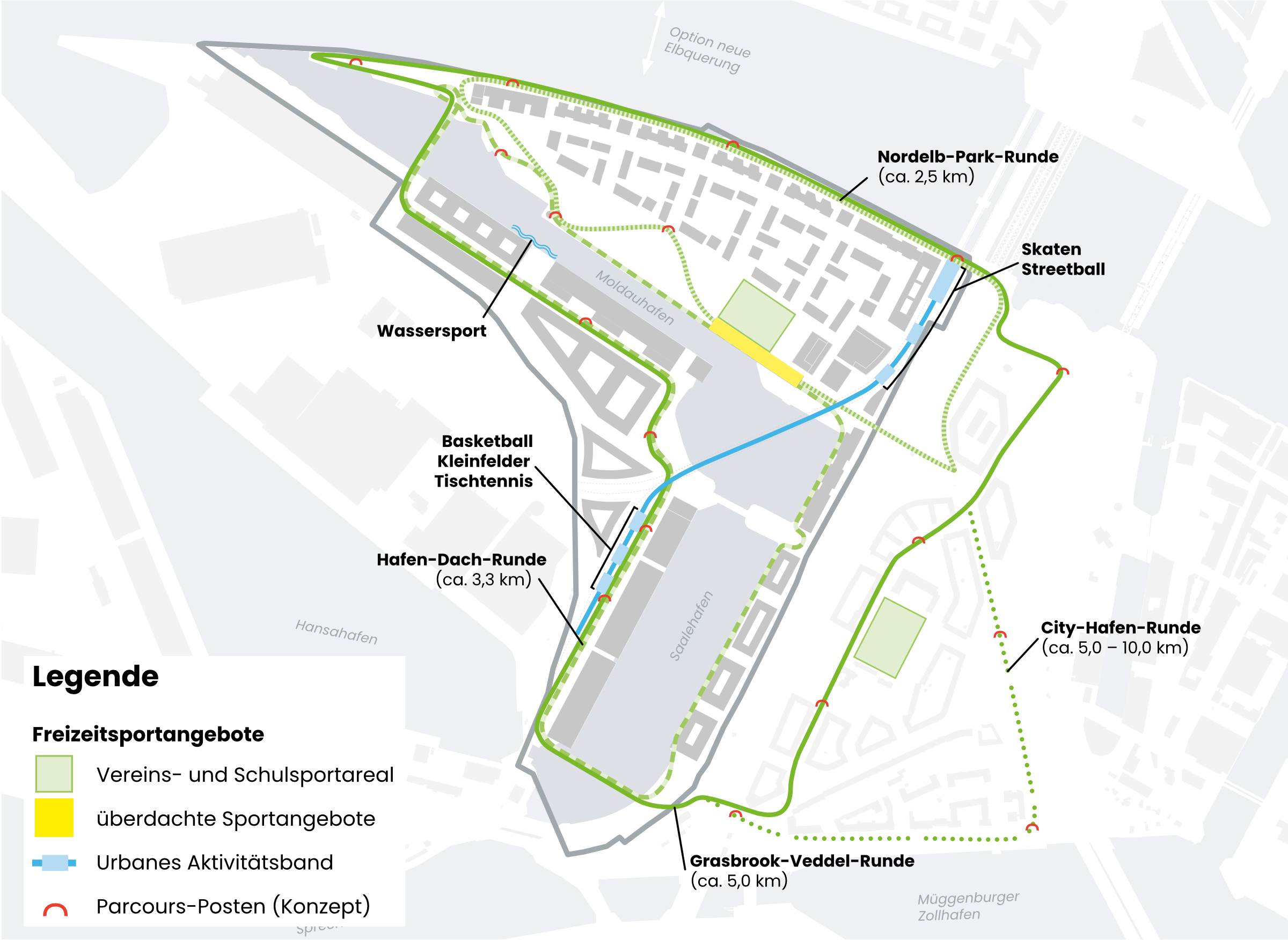
Sports venues and routes in Grasbrook and Veddel © büro luchterhandt & partner
The new "roof" is reminiscent of the old pent roof of the Überseezentrum (overseas center)
For decades, the "Überseezentrum" (overseas center), a large collection and distribution shed with a pent roof, which enabled goods to be handled on the waterfront and protected from the weather, was located on the northern peninsula between the Elbe and Moldauhafen and opened in 1967. The imposing roof continued to shape the area for a long time and was clearly visible from the neighboring Veddel and suburban trains.
The Überseezentrum (overseas center) had to make way for reasons of flood protection and to create more space for apartments. To commemorate this special place, a new roof construction that will have an impressive landmark character in terms of urban planning will be built. The roof will provide the elementary school and the adjacent sports field with a weather-protected area for games and sports. Weekly markets, flea markets and cultural events can also take place here.
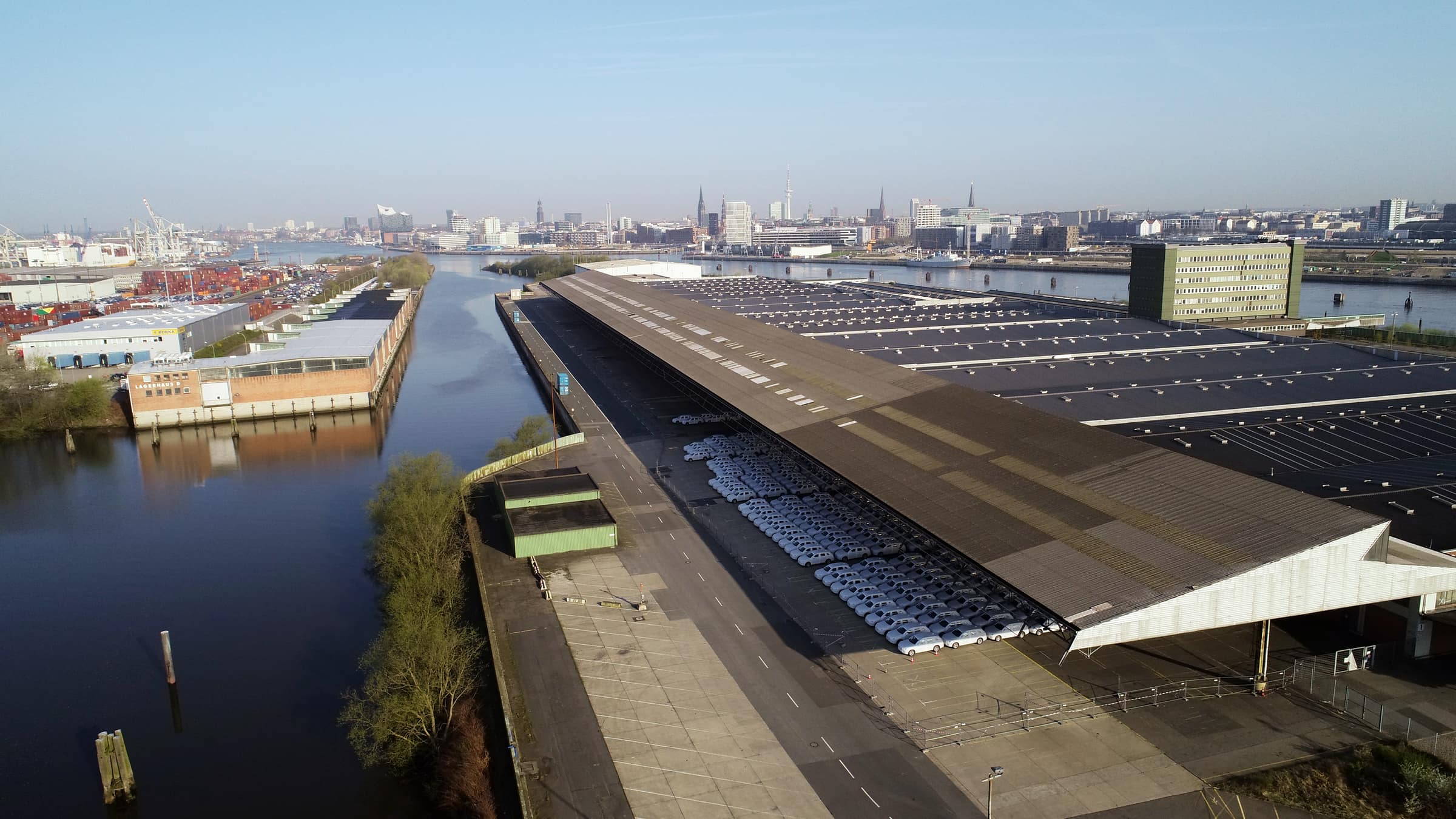
The old pent roof of the Überseezentrum (overseas center) © André Dekker
Urban development
The center around the Moldauhafen connects the two quarters of the district, the Moldauhafenquartier with a residential focus and the commercially characterized Hafentorquartier
Uses
A district for everyone is being created in Grasbrook, with apartments, workplaces and many cultural, educational and leisure facilities
Mobility
A new subway station and a dense network of pedestrian and cycle paths make the use of private cars superfluous in Grasbrook
Sustainability
Key areas of focus in neighborhood development include the use of renewable energy, the responsible use of resources, and construction standards